
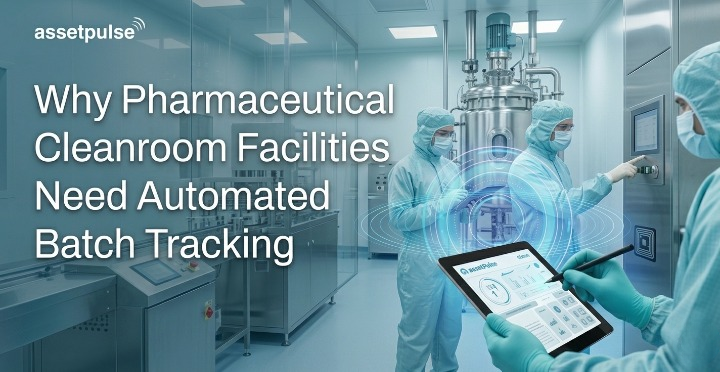

Automated batch tracking is a system that uses technologies like RFID to automatically track each batch as it moves through different process steps in real time. It captures timestamps, location, and status data at every stage, giving teams full visibility, eliminating manual record-keeping, and ensuring accurate, audit-ready traceability.
A batch of injectable chemotherapy drugs leaves the compounding suite. It passes through a sanitization zone, waits outside a Grade B cleanroom, moves through inspection, and eventually clears QC. On paper, that journey is documented. In practice, if you ask a production manager exactly how long that batch sat waiting between sanitization and the cleanroom entrance or which step in the process created the queue, they’ll likely check two or three separate logs and still give you an estimate.
That gap between what’s documented and what actually happened is where pharmaceutical batch tracking software earns its place. For aseptic manufacturing facilities producing injectable medicines, the stakes of that gap are unusually high.
The Tracking Problem Specific to Cleanroom Manufacturing
Pharmaceutical cleanrooms operate under tight environmental and procedural constraints. Batches don’t just move from A to B. They move through gowning zones, airlocks, material transfer hatches, and sanitization bays, each with its own entry and exit protocols. Every transition point is a potential record-keeping gap.
Manual logging at each stage works reasonably well when volumes are low. But as a facility scales, producing hundreds of batches weekly across multiple product lines, the manual approach starts to crack. Staff forget to log a transfer. A batch sits in a holding area while the log sheet sits on someone’s bench. Timestamps get rounded to the nearest hour. None of these are malicious failures; they’re just what happens when you ask people to document everything while also doing the actual manufacturing work.
The consequences show up in two places. First, in quality investigations: when a product issue surfaces, reconstructing the precise batch journey from manual records takes time and rarely produces a clean picture. Second, in efficiency: without reliable timing data from each process step, identifying genuine production bottlenecks is largely guesswork.
How RFID-Based Batch Tracking Works in a Cleanroom Environment
RFID tracking in pharmaceutical cleanrooms works by tagging the carriers used to move batches through the facility — such as totes, trays, carts, or secondary containers — and placing fixed RFID readers at key transition points. Those readers capture entry and exit events automatically, without any manual scan or staff intervention.
The result is a time-stamped movement record for every batch, built passively as production runs. When a tote enters a sanitization area, the system logs it. When it exits and waits at the Grade B cleanroom airlock, that wait time is recorded. When it clears inspection and moves to QC, there’s a timestamp for that too. No paper log. No rounding.
What This Looks Like Across a Typical Process Flow
- Batch tagged at compounding or preparation — movement tracking begins from the point of origin
- Fixed reader at sanitization zone entrance and exit captures dwell time in that area
- Reader at cleanroom airlock logs wait time before controlled entry — a key bottleneck indicator
- Production zone readers record time in active manufacturing steps
- Inspection station reader captures time in QC hold and inspection
- Final release or storage transfer completes the batch record automatically
Real-time visibility works because the readers at each transition point are fixed, not handheld. Handheld readers require a staff member to physically scan each batch and then sync the device to the server before the dashboard reflects any update — which means there’s always a lag between what’s on the floor and what the system shows. Fixed readers eliminate that lag entirely. Every entry and exit event is captured automatically and reaches the dashboard the moment it happens.
Each of these events feeds directly into the AssetGather dashboard. A production manager or supervisor can put that dashboard on a screen in the control room or at a workstation and have a live read on batch movement throughout the entire working day. If a batch has been sitting in the transfer zone longer than expected, it shows up. If sanitization is running behind and creating a queue at the cleanroom entrance, that’s visible before it becomes a bigger problem. The system doesn’t just record what happened — it shows you what’s happening right now.
From Location Data to Production Intelligence
Location tracking is useful. What pharmaceutical manufacturers actually need, though, is what comes from that data over time.
Cycle Time Measurement
When every batch movement is automatically logged, you get accurate cycle time data for each process step — not estimated, not averaged from weekly reports, but measured from actual timestamps. That data tells you how long compounding really takes versus how long the schedule assumes it takes. It shows you whether the sanitization step consistently runs over on Tuesday afternoons. It gives quality teams a factual basis for investigating deviations rather than reconstructing events from memory.
Bottleneck Identification
Queue time at cleanroom entrances is one of the most common and least visible sources of production delay in aseptic manufacturing. Batches pile up at airlocks, at inspection stations, at material transfer hatches, and the delay looks like a scheduling problem when it’s actually a capacity or sequencing problem. RFID data makes those queues visible in a way that manual records never do, because the waiting time is captured whether anyone is watching or not.
Complete Audit Trail for GMP Compliance
GMP regulations, EU Annex 1, and MHRA requirements all demand detailed batch records. An RFID-generated audit trail provides exactly that — a complete, time-stamped, tamper-evident record of every transition a batch made through the facility. During an inspection, pulling the full history of a specific batch takes seconds. During an internal deviation investigation, the data is already there and doesn’t need to be reconstructed.
Making It Work in a Controlled Environment
Deploying RFID in a pharmaceutical cleanroom isn’t the same as deploying it in a warehouse. Tag selection matters — materials need to be compatible with sanitization chemicals and autoclave cycles if applicable. Reader placement needs to account for cleanroom airflow, wall penetrations, and the protocols governing what equipment enters controlled zones.
A structured approach to deployment makes a real difference:
- Site survey to map transition points, understand cleanroom classifications, and identify reader locations that capture movement without compromising environmental controls
- Tag selection matched to the specific carriers used — totes, trays, or secondary packaging — and validated for compatibility with sanitization methods in use
- Integration with existing Manufacturing Execution Systems (MES) or LIMS so batch tracking data flows into the broader quality and production record without manual re-entry
- Staff onboarding focused on reading the dashboard and acting on alerts, not on operating the tracking system itself which runs passively once deployed
The facilities that get the most from RFID batch tracking are the ones that treat the data as a production management tool from day one, not just a compliance record. Cycle time reports get reviewed in shift handovers. Bottleneck data feeds into capacity planning. QC teams use the audit trail as a first step in any deviation investigation.
The Operational Case Beyond Compliance
For a high-volume aseptic facility producing injectable medicines, whether chemotherapy drugs, nutrition products, or clinical trial materials – production efficiency has direct patient impact. Delays in the manufacturing cycle mean delays in supply to clinical teams. Bottlenecks that aren’t visible don’t get fixed.
RFID-based pharmaceutical batch tracking addresses both sides of that: it builds the compliance record automatically, and it generates the production data that manufacturing teams need to keep cycle times tight and supply reliable. Those aren’t separate goals that require different systems. They come from the same underlying data.
Facilities that have deployed automated batch tracking consistently report the same outcomes: faster investigation turnaround when deviations occur, clearer visibility into where production time is actually going, and a significant reduction in the administrative overhead of maintaining manual batch records.
See It Working in a Facility Like Yours — Book a Free Demo
If you’re running a cleanroom manufacturing facility and still piecing together batch records from multiple logs at the end of a shift, you already know the problem. The data exists — it’s just scattered, incomplete, and always a step behind what’s actually happening on the floor.
An RFID-based batch tracking system changes that from day one. Every process step — set-up, transfer, sanitization, checking, batch production, visual inspection — gets a timestamp automatically. Your configurable dashboard shows exactly where every batch is, how long it’s been there, and where things are slowing down. No chasing logs. No end-of-shift reconstruction. Just a clear, accurate picture of your production floor, all day long.
If your team is still chasing batch records at the end of a shift, the problem isn’t your people — it’s the process. A facility running at the pace of modern pharmaceutical manufacturing needs visibility that keeps up. Every batch, every step, every minute — tracked automatically, displayed in real time, ready for audit without anyone lifting a pen. That’s not a future state. It’s available now.
About AssetPulse
AssetPulse builds RFID-based batch and asset tracking solutions for pharmaceutical cleanrooms, research labs, and life sciences manufacturing environments. Their AssetGather platform delivers configurable real-time dashboards, automated cycle time measurement across every process step, and GMP-compliant audit trails — giving production teams the visibility they need to run a tighter, more transparent manufacturing operation from the first shift to the last.


