
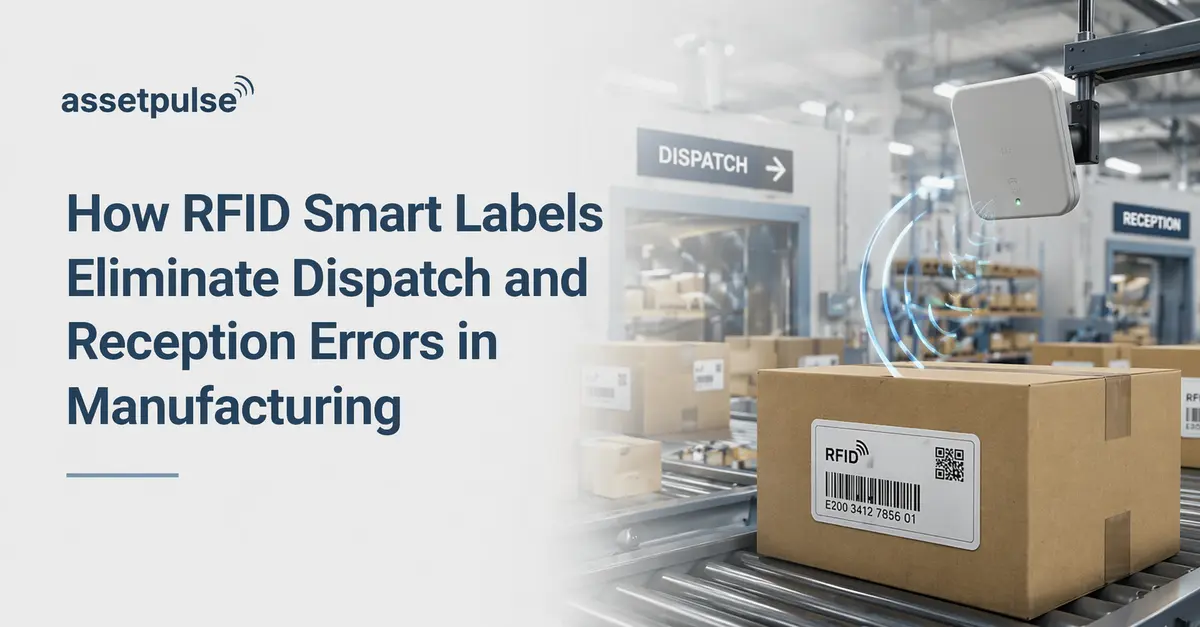

RFID smart labels are adhesive labels embedded with RFID chips and antennas that use radio waves to identify and track items without line-of-sight scanning. They enable fast, accurate verification of assets and shipments, improving visibility and reducing manual effort.
Every day, manufacturers load and receive dozens of transport units—pallets of raw materials from suppliers, containers of components between facilities, and bins of finished products to customers. Each handoff represents a critical verification point where errors can disrupt production schedules, create billing disputes, and compound into persistent inventory discrepancies. Traditional verification methods create bottlenecks at loading docks while wasting valuable time.
RFID smart labels offer a better solution for transport unit verification at dispatch and reception points.
The Loading Dock Verification Challenge
Manufacturing operations depend on accurate handoffs between suppliers and customers. Each transport unit must be verified at two critical checkpoints: when suppliers load trucks for dispatch and when customers receive shipments.
These verification points face common challenges:
- Time pressure: Loading docks operate on tight schedules
- Volume complexity: Trucks carry dozens or hundreds of units simultaneously
- Manual processes: Workers verify each unit individually
- Documentation burden: Multiple forms require separate data entry
- Error risk: Miscounts and missed units happen frequently
When verification fails at dispatch, suppliers ship incorrect quantities. When verification fails at reception, customers accept shipments without knowing what arrived. Both scenarios create costly problems that surface later.
What are RFID Smart Labels?
RFID smart labels combine standard adhesive paper labels with embedded RFID technology. Each label contains a microchip and antenna that stores unique identification data for the transport unit.
The labels attach directly to pallets, bins, containers, or crates. Once applied, they transform ordinary packaging into smart assets that can be verified wirelessly.
Unlike barcodes that require line of sight and individual scanning, RFID smart labels communicate through radio waves. This fundamental difference enables entirely new verification approaches at loading and receiving areas.
How Smart Label Verification Works
The RFID smart label process simplifies dispatch and reception verification through two key checkpoints.
Supplier Dispatch Verification
Before a loaded truck departs, the supplier conducts a final check:
- Workers load transport units onto the truck
- A handheld RFID reader is waved near the loaded truck
- The reader captures data from all RFID smart labels simultaneously
- The system confirms which transport units are present
- Missing or extra units are identified immediately
- The verified load matches against the shipment manifest
This process takes seconds instead of minutes. No climbing into trucks. No visual inspection of each label. No manual counting.
Customer Reception Verification
When the shipment arrives, the customer performs the same verification process: the loaded truck arrives at the receiving dock, a handheld RFID reader scans all transport units at once, and the system compares received units against the expected manifest. Discrepancies are identified before unloading begins, and acceptance is documented with precise digital records.
Reception staff know exactly what arrived before moving a single pallet, catching discrepancies immediately while the delivery driver is still present.
Key Advantages over Traditional Methods
RFID smart labels deliver specific benefits at dispatch and reception checkpoints.
Bulk Scanning Capability
Traditional barcode verification requires scanning each transport unit individually. With RFID smart labels, handheld readers capture data from multiple units simultaneously:
- Scan through shrink wrap and packaging materials
- Read labels on stacked pallets without moving them
- Verify entire truck loads in a single pass
- Capture data from units in difficult-to-reach positions
A verification process that once took 15-20 minutes now completes in under one minute.
Immediate Error Detection
RFID verification identifies problems instantly:
- Missing transport units are flagged before trucks depart
- Extra units loaded by mistake are detected immediately
- Wrong items are caught before they enter the supply chain
- Counts are verified automatically without manual tallying
Problems are resolved on the spot rather than discovered days later.
Elimination of Manual Data Entry
RFID smart labels eliminate redundant data entry:
- Verification data flows directly into shipping systems
- No manual recording of unit numbers or quantities
- No transcription errors from paper manifests
- No double-entry between supplier and customer systems
Dispute Prevention
Digital verification creates indisputable records:
- Timestamped proof of dispatch verification
- Documented record of reception confirmation
- Clear accountability for discrepancies
- Audit trail for billing and compliance
When both parties verify with RFID, disputes about shipment contents decrease dramatically.
Real-World Applications
RFID smart labels work across diverse manufacturing scenarios. Suppliers attach them to pallets of raw materials, enabling manufacturers to verify incoming deliveries instantly at receiving docks. Multi-site manufacturers use smart labels when moving components between facilities for quick verification at both dispatch and reception. For finished product shipments, manufacturers attach smart labels to pallets before shipping, with final loading verification confirming correct items and quantities. Reusable pallets and crates, significant investments, benefit from smart label verification at dispatch and return reception. High-value items like electronics and pharmaceuticals require precise chain of custody, where RFID verification creates clear accountability for critical shipments.
Simple Implementation Considerations
Deploying RFID smart label verification requires minimal infrastructure.
- Label Application: Labels apply like standard shipping labels. No special equipment required beyond label printers. Labels withstand typical shipping conditions.
- Handheld Readers: Both suppliers and customers need portable RFID readers. Readers are easy to use and connect to existing systems via WiFi or USB.
- System Integration: Verification data integrates with existing manufacturing software including shipping management, receiving systems, and ERP platforms.
- Staff Training: Workers adopt RFID verification quickly. Point the reader toward loaded units, press scan, review results. Training requires less than 30 minutes per person.
Partner with AssetPulse for Smart RFID Solutions
AssetPulse provides industrial manufacturers with RFID smart label systems designed for dispatch and reception verification. With manufacturing-focused expertise and real-world industrial experience, we deliver accurate, efficient transport unit verification that eliminates errors and accelerates operations.
Our complete solution package includes everything needed: RFID smart labels compatible with your transport units, rugged handheld readers built for industrial use, software integration with existing systems, and comprehensive staff training and deployment support. Start with pilot deployments and expand across multiple facilities and partners as ROI proves value.
Eliminate Verification Errors Today
Transport unit verification at dispatch and reception is a critical control point in manufacturing operations. Traditional manual methods create delays, errors, and disputes that impact productivity and profitability.
RFID smart labels transform verification from a time-consuming bottleneck into an instant confirmation process. The technology is proven, affordable, and ready to deploy with immediate, measurable benefits.
Ready to Transform Your Verification Process?
Contact AssetPulse today for a free consultation and discover how RFID smart labels can streamline your dispatch and reception operations.


