

The production lead stared at the computer screen in frustration. Again. The production line had been stalled for 40 minutes while the team hunted for a critical calibration tool worth $35,000. The spreadsheet showed it in Lab 3 — a location that had already been checked twice.
This scene plays out thousands of times daily across facilities worldwide. Equipment goes missing. Teams waste hours searching. Production stops. And everyone asks the same question: “Why can’t we just know where everything is?”
Traditional tracking methods—spreadsheets, manual logs, and periodic barcode scans—can’t keep pace with modern operations. They create blind spots where expensive assets disappear. They generate outdated data that leads to bad decisions. And they consume hours of productive time in fruitless searching.
Bluetooth Low Energy asset tracking changes this equation entirely. It answers the “where is it?” question in seconds instead of hours, automatically, without requiring anyone to scan barcodes or update spreadsheets.
Understanding BLE Technology and Why It Works
Before diving into solutions, let’s get clear on what BLE is and why it’s so effective for asset tracking.
Bluetooth Low Energy isn’t just regular Bluetooth with a different name. It’s a fundamentally different protocol designed for transmitting small amounts of data while consuming minimal power. Where your Bluetooth headphones drain their battery in hours, a BLE tag can run for three to five years on a coin cell battery.
This matters enormously for asset tracking. Nobody wants to change batteries on hundreds of tags every few weeks. BLE’s ultra-low power consumption makes large-scale deployments practical and affordable.
BLE operates in the same 2.4 GHz band as Wi-Fi but uses a different approach. Instead of maintaining constant connections, BLE tags broadcast short signals at regular intervals. These signals contain a unique identifier and sometimes additional data like temperature or motion status. The signals travel roughly 30 to 300 feet depending on the tag’s configuration and environment—perfect for indoor facilities where you need zone-level accuracy without GPS-level precision.
How BLE Asset Tracking Actually Works
Walk into a BLE-enabled facility and you won’t see much difference. The magic happens invisibly through three components working together.
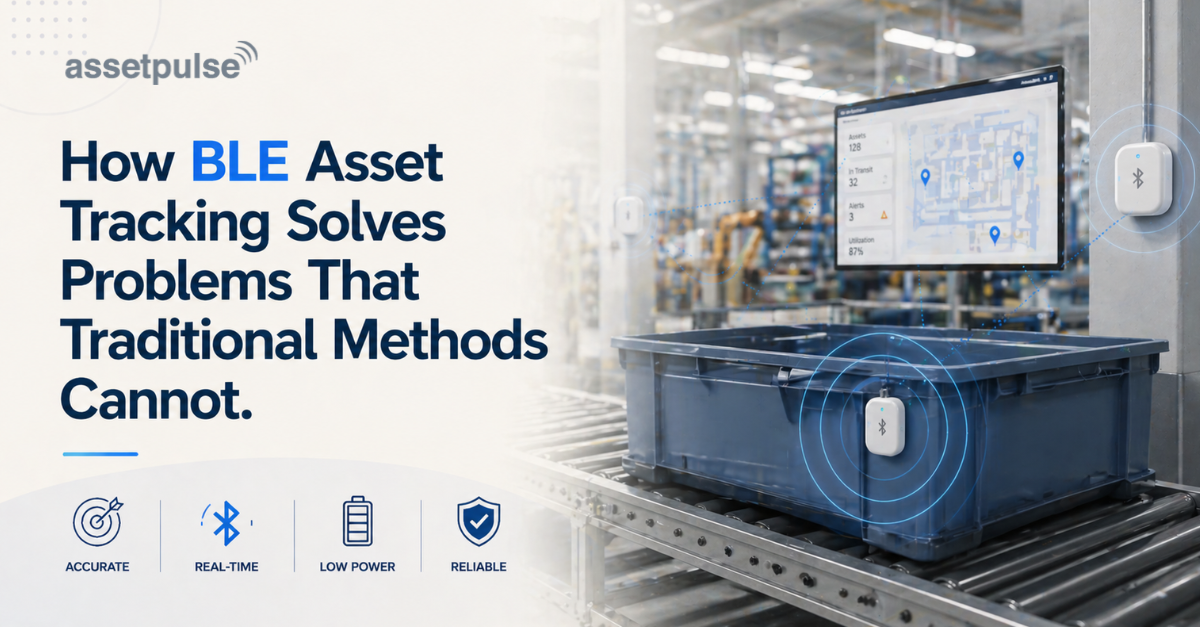
First, you attach small BLE beacons or tags to every asset you want to track. These tags, roughly the size of a car key fob or smaller, stick onto equipment, tools, or inventory containers. Once activated, they broadcast their presence continuously without any manual intervention.
Second, BLE gateways or receivers installed throughout your facility listen for tag signals and determine which tags are nearby. A typical 50,000 square foot facility might need 20 to 40 gateways depending on layout.
Third, asset tracking software, like AssetGather, processes all incoming data and presents it through dashboards and reports. When someone asks, “Where’s the microscope?”, the system checks which gateway most recently detected that tag. Lab 3. Northwest corner. Last seen 30 seconds ago.
This zone-level accuracy, knowing which room or area contains an asset, solves most real-world tracking problems. You don’t need pinpoint precision. You just need to know which zone to check, cutting search time from hours to minutes.
Problems BLE Tracking Eliminates
Let’s get specific about what changes when you deploy BLE tracking.
Lost assets become findable in seconds. Instead of spending time hunting for equipment that’s simply been moved, the system pinpoints its exact location in seconds. No more wandering between labs. No more wasted minutes or buying replacements that weren’t needed. Teams typically save 30–60 minutes per incident and save thousands in operational costs each year.
Inventory counts shift from days to hours. Instead of relying on slow, manual checks, the system automatically reports every tag detected in each zone. Discrepancies stand out instantly. Most teams cut their inventory cycle times dramatically — often from several days to just a few hours.
Maintenance becomes proactive instead of reactive. When a centrifuge approaches its calibration deadline, the system alerts the maintenance team automatically. No spreadsheets to check. No missed deadlines. Just automated reminders ensuring equipment stays compliant.
Utilization rates reveal hidden opportunities. It’s common to find high-value equipment sitting idle while other teams rent similar assets. With actual usage data, organizations can redistribute under-used resources and eliminate large, recurring rental costs.
Compliance documentation becomes automatic. BLE systems automatically log every location change, every zone entry and exit, timestamped and complete. When auditors arrive, you export the reports in minutes instead of scrambling to reconstruct events from paper logs.
Industries Seeing Dramatic Improvements
Manufacturing facilities track tools, work-in-progress inventory, and quality control equipment. For example, with BLE tracking, automotive parts manufacturers can gain clear visibility into the location and status of every specialized tool. What once went missing between production lines becomes instantly traceable, allowing teams to see what’s in use, what’s available, and where everything is. Tool hoarding drops, workflows speed up, and overall productivity increases.
Laboratories and life sciences facilities depend on precision instruments requiring strict calibration. With BLE asset tracking, these environments can instantly locate critical assets such as pipettes, analyzers, and sample containers without interrupting ongoing work. Researchers spend less time searching and more time running experiments. Calibration schedules are easier to manage because the system automatically identifies equipment that’s approaching or past its due date. The result: smoother workflows, higher compliance, and fewer delays in research activities.
Healthcare organizations manage enormous inventories of mobile equipment: wheelchairs, infusion pumps, beds, monitoring devices. With BLE tracking, hospitals can quickly see exactly where these assets are, reducing the need to rent equipment they already own but can’t locate. Real-time visibility minimizes search time, prevents unnecessary rentals, and ensures critical equipment is available when patients need it.
IT departments oversee laptops, servers, and networking equipment spread across buildings. BLE tracking gives teams accurate, real-time insight into asset locations and movements, dramatically reducing loss and misplaced equipment. Allocation becomes data-driven instead of reactive, helping IT teams optimize resources and respond faster to internal requests.
Cleanroom environments present unique challenges. Traditional barcode scanning requires manual handling, which increases contamination risk. BLE tags track tools and materials automatically as they move through cleanroom zones without requiring workers to scan each item.
BLE vs Alternative Tracking Technologies
Understanding when BLE makes sense requires knowing how it compares to alternatives.
BLE vs RFID: Radio Frequency Identification excels at certain applications, particularly outdoor yards and high-volume inventory automation. RFID readers can scan hundreds of tags simultaneously, making them ideal for portal-based tracking like pallets moving through doorways.
BLE offers advantages for indoor tracking where you need continuous visibility. BLE tags broadcast constantly, providing real-time location updates. RFID tags only respond when scanned by a reader. For assets moving frequently between zones, BLE creates a more complete activity trail.
At AssetPulse, we deliver RFID and BLE asset tracking solutions across a wide range of industries—including pharma labs, biomedical device manufacturing, cleanrooms, R&D labs, data centers, construction sites, oil & gas operations, warehouses, and more—where fast, accurate asset identification and audit efficiency are critical.
We typically recommend RFID for high-speed inventory audits, item-level tracking, and environments requiring rugged, battery-free tags.
We recommend BLE for indoor real-time location tracking, continuous visibility, and applications where environmental sensing or movement monitoring is essential.
Many organizations get the best results from a hybrid RFID + BLE deployment, leveraging each technology where it performs best to achieve complete, end-to-end asset visibility.
BLE vs GPS: GPS provides precise outdoor positioning but fails indoors. Signals can’t penetrate buildings effectively. Power consumption is high. BLE fills the indoor gap GPS can’t reach, works inside buildings where GPS struggles, and battery life measures in years, not days.
BLE vs Wi-Fi Location Systems: Wi-Fi-based tags consume more power than BLE, requiring more frequent battery changes. BLE operates on a separate network dedicated to tracking, so tags last longer and you don’t introduce tracking traffic onto your production network.
Implementation and ROI
A typical mid-sized facility (50,000 to 100,000 square feet) can be fully operational in 3 to 8 weeks from project kickoff to go-live. This includes site survey, gateway placement, tag provisioning, software configuration, and staff training.
Integration with existing business systems typically happens through REST APIs or pre-built connectors. Most BLE platforms integrate smoothly with major ERP systems (SAP, Oracle), CMMS platforms (Maximo), and warehouse management systems.
BLE tracking pays for itself through multiple channels. If your team spends 5 hours weekly searching for assets, that’s 260 hours annually. At $35 per hour loaded cost, you’re burning $9,100 yearly on searching. BLE typically reduces search time by 80-95%.
Asset loss represents another major cost. Organizations might lose $30,000 to $100,000 annually replacing “missing” equipment that’s just misplaced. BLE tracking typically recovers 70-90% of these costs.
Utilization improvements unlock hidden value. When you discover expensive equipment sits idle while you’re renting similar equipment, you can eliminate those rental costs. Automated maintenance alerts reduce equipment failures and extend asset life.
Most organizations implementing BLE tracking report 12 to 18-month payback periods when accounting for all benefits. Larger facilities with more valuable assets often see faster returns.
Security and Compliance
Modern BLE systems implement multiple security layers. BLE signals use encryption to prevent unauthorized reading. Gateway-to-server communication uses HTTPS with token-based authentication. Role-based access controls ensure users only see relevant data.
Audit logs track every system access, recording who viewed what data when. For regulated industries, these logs support compliance documentation. For pharmaceutical facilities, they align with FDA documentation standards.
Advanced Capabilities
Many BLE tags include environmental sensors monitoring temperature, humidity, shock, and motion. A pharmaceutical cold-chain application can track vaccine shipments, alerting immediately if temperature excursions occur.
Geofencing creates virtual boundaries triggering alerts when assets enter or exit defined zones. A hospital might alert when expensive surgical instruments leave the surgical suite.
Predictive maintenance uses movement and usage data to forecast when equipment might need service. Instead of fixed schedules, you can shift to condition-based maintenance using actual usage patterns.
Getting Started
If you’re dealing with lost assets, wasted search time, compliance headaches, or utilization questions, BLE tracking might be your answer. Start by identifying your biggest pain points. Where do you spend the most time searching? Which assets go missing most frequently?
Consider whether BLE, RFID, or a hybrid approach best fits your needs. Indoor facilities with mobile assets benefit most from BLE. Outdoor yards favor RFID. Many organizations use both.
AssetPulse has deployed asset tracking systems across manufacturing, laboratory, healthcare, and warehouse environments. We can assess your situation, recommend the right technology mix, and implement solutions that deliver measurable results.
The difference between frustration and control often comes down to knowing where your assets are. BLE tracking answers that question automatically, continuously, and reliably. It transforms searching into finding, guessing into knowing, and chaos into clarity.
Ready to stop searching and start finding? Contact AssetPulse today for a free consultation on how BLE asset tracking can transform your operations.


