
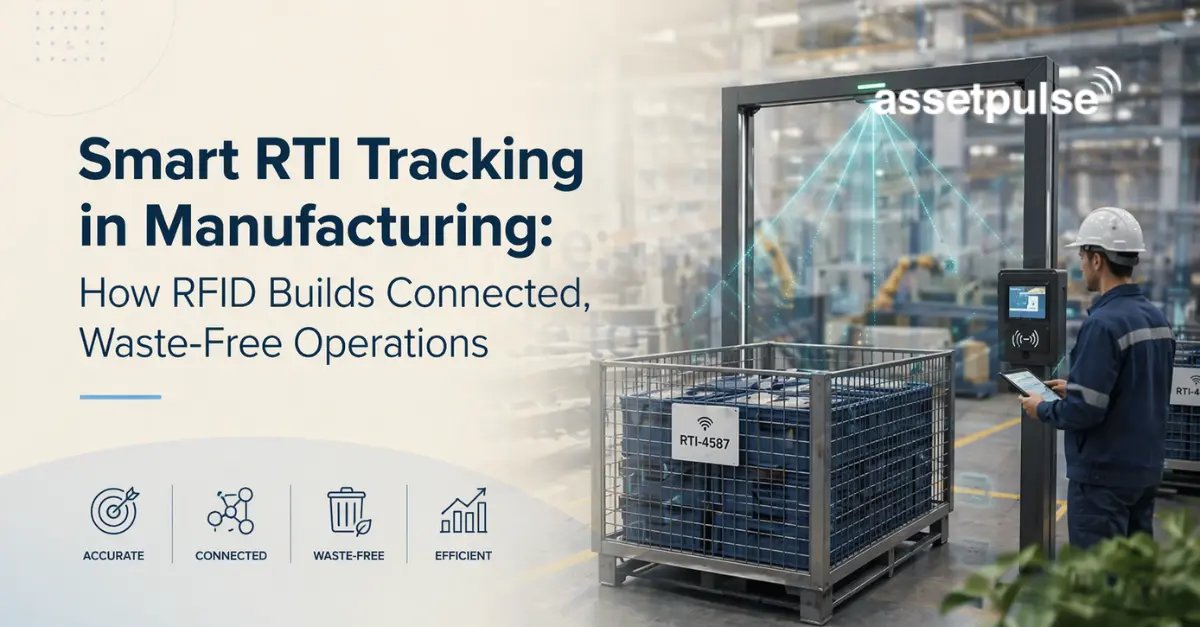

What is RTI Tracking?
RTI tracking in manufacturing is the process of monitoring reusable transport items such as pallets, crates, bins, and containers as they move through production, storage, shipping, and supplier networks. Instead of relying on manual logs or line-of-sight barcode scans, modern RTI tracking uses RFID to capture movement automatically, improve accuracy, reduce losses, and give manufacturers real-time visibility across multiple facilities. It helps teams control reusable assets better, cut replacement costs, and keep operations running smoothly.
Every manufacturer depends on containers, pallets, bins, and cages that transport raw materials and finished goods between facilities. These reusable units, known as returnable transport items (RTIs), keep production lines flowing and supply chains moving. Yet managing them effectively remains one of the biggest blind spots in operational visibility.
Tracking RTIs manually causes bottlenecks, higher costs, and inefficiencies that impact the entire supply chain. RFID technology provides industrial manufacturers with an automated solution that eliminates tracking errors and ensures accountability across multi-site operations.
What are RTIs and Why They Matter
RTIs are reusable packaging assets that circulate throughout a manufacturer’s ecosystem. These include wooden and plastic pallets, folding crates, roll cages, metal drums, tote boxes, ingredient bins, intermediate bulk containers (IBCs), gas cylinders, and beverage kegs. Each RTI represents a capital investment designed to reduce packaging waste while ensuring consistent, standardized product handling.
The value proposition is clear: instead of purchasing single-use packaging for every shipment, manufacturers invest in durable containers that cycle repeatedly through their operations. This approach reduces material costs, minimizes environmental impact, and supports circular economy principles.
However, untracked RTIs quickly become operational liabilities. Containers go missing at supplier sites, accumulate unused in remote storage areas, or disappear entirely from inventory systems. Over time, this leads to excess capital tied up in replacement purchases, reduced asset utilization rates, and persistent inventory discrepancies that erode operational efficiency.
Key Challenges in Traditional RTI Tracking
Industrial manufacturers typically encounter these problems with manual tracking methods:
- Loss and Shrinkage: Containers routinely disappear when shipped to external suppliers or distribution partners. Without automated tracking, manufacturers have no reliable way to identify when or where assets leave their control.
- Manual Logging Delays: Workers must physically record container movements using spreadsheets or basic scanning systems, creating time-consuming administrative work that pulls resources away from value-added activities.
- Limited Multi-Site Visibility: Manufacturers operating multiple facilities struggle to track RTI movements between locations. Containers that should be circulating efficiently instead accumulate at specific sites, creating artificial shortages elsewhere.
- Costly Replacements: When tracking systems fail, manufacturers resort to purchasing additional RTIs to compensate for missing units. These unnecessary purchases inflate operating costs and mask underlying process inefficiencies.
- Compliance Documentation Gaps: Quality audits and regulatory inspections require verifiable records that manual systems cannot reliably provide, creating compliance risks.
Barcode systems offer partial improvement over spreadsheets, but they still require line-of-sight scanning and manual data entry at each checkpoint. For modern manufacturing plants running continuous 24/7 operations across multiple facilities, these limitations create unacceptable gaps in operational visibility. These persistent challenges demand an asset tracking solution that operates continuously, automatically, and accurately across complex multi-site manufacturing environments.
RFID: Automated Tracking for Industrial Environments
Radio Frequency Identification (RFID) transforms RTI tracking from a manual administrative burden into an automated data collection process. The technology works through durable RFID tags embedded in or attached to containers, combined with fixed readers installed at strategic facility locations.
Unlike barcodes that must be individually scanned, RFID readers automatically detect all tagged containers passing through their read zones. This happens instantaneously, without requiring worker intervention or line-of-sight positioning. A single reader can simultaneously capture data from dozens of containers as they move through loading docks, storage areas, or production zones.
Modern RFID implementations integrate with cloud-based management platforms that aggregate data across facilities. Manufacturers gain complete visibility into where containers are located, whether at supplier docks, in transit between facilities, staged for production use, or returned to central distribution.
RTI Tracking Applications Across Industries
RFID-enabled RTI management works seamlessly across various manufacturing environments:
- Food Processing: Track ingredient bins and food-grade totes moving between preparation, processing, and packaging areas while maintaining hygiene compliance records.
- Electronics Assembly: Monitor plastic totes and component carriers moving through cleanroom environments, ensuring proper handling and preventing contamination.
- Automotive Manufacturing: Manage returnable racks and specialized containers transporting parts between suppliers and assembly plants, reducing costly container losses.
- Chemical Production: Ensure secure cylinder and drum tracking that supports safety and regulatory requirements.
- Consumer Goods: Track roll cages and pallets circulating through distribution networks, improving turnaround times and reducing shrinkage.
Each application delivers measurable ROI through reduced container losses, improved utilization rates, and enhanced operational efficiency.
Operational Advantages for Manufacturers
- Instant Location Visibility: Every RTI movement is automatically recorded as containers enter or exit facilities. Managers can view real-time locations through centralized dashboards, eliminating time wasted searching for missing assets.
- Reduced Total Cost of Ownership: Automated tracking dramatically reduces container loss rates and improves asset utilization. Manufacturers decrease replacement purchases while maximizing returns on existing RTI investments.
- Data Accuracy and Reliability: RFID systems eliminate manual data entry errors. Automated capture ensures inventory records accurately reflect physical asset locations, supporting better planning and forecasting.
- Quality and Compliance Support: Continuous tracking creates verifiable audit trails that demonstrate chain-of-custody compliance. Manufacturers can instantly retrieve historical movement data for ISO audits, quality investigations, or regulatory inspections.
- Sustainability Impact: Higher RTI reuse rates directly reduce packaging waste and carbon footprint. RFID data provides measurable evidence of environmental performance, supporting corporate sustainability reporting, and ESG commitments.
- Enterprise System Integration: Direct integration with ERP, WMS, and MES systems enable automatic data exchange across production operations. When tagged containers enter assembly areas, systems automatically update material availability, eliminating duplicate data entry, and ensuring consistent information across all business functions.
Beyond logistics efficiency, RFID-generated data helps make better business decisions. Production planners can optimize material flow by understanding actual container availability and circulation patterns. This prevents bottlenecks, reduces idle equipment time, and improves overall equipment effectiveness (OEE).
AssetPulse Solutions: Purpose-Built for Industrial Visibility
Implementing these capabilities requires a platform designed specifically for manufacturing environments. AssetPulse helps industrial manufacturers streamline operations with intelligent RFID-based asset tracking systems that deliver real-time visibility of RTIs, containers, tools, and production assets. Engineered specifically for rugged factory environments, the AssetPulse platform improves accountability, optimizes material flow, and ensures compliance across manufacturing sites.
The solution provides actionable analytics that reduce waste, cut operating costs, and advance sustainability objectives. Manufacturers using AssetPulse RFID solutions can gain complete control over their assets – anytime, anywhere—with systems designed for industrial reliability and scalability.
Transform Your RTI Management Today
RFID technology has evolved from an emerging solution to an essential enabler of efficient manufacturing operations. By automating RTI tracking, manufacturers eliminate waste, enhance operational visibility, and build more sustainable supply chains.
The technology delivers immediate, measurable impact: reduced container losses, improved asset utilization, better inventory accuracy, and comprehensive compliance documentation. As manufacturing continues advancing toward digital transformation and Industry 4.0 principles, RFID-based RTI tracking provides the foundation for smarter, more connected operations.
AssetPulse specializes in delivering RFID-based RTI tracking solutions across diverse industries and environments. With successful implementations across multiple sites, our team brings proven expertise to help organizations improve visibility, reduce losses, and scale their operations with confidence.
Ready to eliminate RTI tracking inefficiencies?
Contact AssetPulse today for a free consultation and discover how RFID can reduce your container losses and improve asset utilization.


