
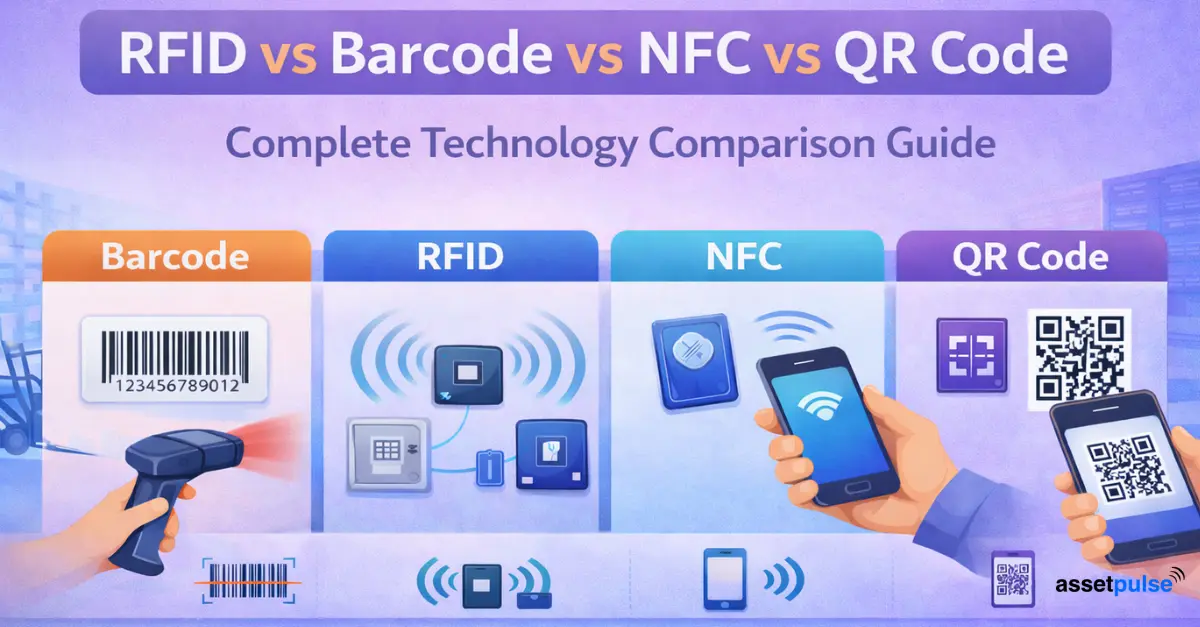

Asset tracking used to be a manual, tedious chore. Today, multiple technologies compete for your attention—RFID, barcodes, NFC, and QR codes each promise to solve your asset tracking challenges. But which one actually delivers for your specific operation?
Unlike barcodes or QR codes that need direct line of sight, RFID can scan hundreds of items at once, even if they’re tucked inside a box or moving down a conveyor belt. NFC offers secure, close-range communication perfect for authentication. Each technology has distinct strengths and limitations.
This complete comparison guide examines how RFID stacks up against barcodes, NFC, and QR codes across real-world metrics that matter: read range, speed, accuracy, cost, and durability. You’ll get the data you need to choose the right technology for your manufacturing, labs, IT, healthcare, or warehouse operations.
Which Asset Tracking Solution is Right for You?
Get expert guidance to choose between RFID, barcode, NFC, or QR codes
Get Free ConsultationRFID vs Barcode vs NFC vs QR Code: Understanding Asset Tracking Technologies
At its core, RFID uses radio waves to communicate with RFID tags attached to your assets. This represents a fundamental shift from visual scanning technologies like barcodes and QR codes. While a worker must find and aim at every individual barcode, an RFID system can pick up hundreds of tags per second, even if tags are hidden behind objects or moving through a loading dock.
NFC (Near Field Communication) offers a middle ground: wireless communication like RFID, but at very close range (a few centimeters). QR codes provide smartphone-readable visual markers that anyone can scan without special equipment.
This guide provides comparison across all four technologies, examining hardware components, performance metrics, cost considerations, and real-world implementation scenarios. You’ll gain clarity on which technology—or combination of technologies—aligns with your specific operational needs and budget constraints.
Common Asset Tracking Challenges
Manual or outdated asset tracking creates critical operational challenges:
- The Manual Bottleneck: Every time someone must find a barcode and aim a scanner, time is lost. This slows down inventory counts and material movement. An audit that takes a warehouse team hours with barcodes can often be done in minutes with RFID, or completed instantly by consumers with QR codes.
- The Line-of-Sight Problem: Barcodes and QR codes are useless if they’re smudged, facing the wrong way, or buried under other boxes. Workers waste significant time repositioning items or cleaning labels just to get a good scan.
- The Human Factor: Manual scanning is prone to errors. People miss items, scan things twice, or type in wrong data. These small mistakes compound into inaccurate inventory and “ghost” assets that exist in your system but not in reality.
- Sluggish Throughput: Manual checkpoints at shipping and receiving create bottlenecks. When every pallet requires someone to stop and scan, your entire operation slows down.
- Limited Real-Time Visibility: Without automation, you only know where an item was the last time someone manually scanned it. You can’t get instant alerts if something goes missing or ends up in the wrong location.

Modern tracking technologies—RFID, NFC, barcodes, and QR codes—each address these challenges differently. Know how each technology captures data and you can evaluate the right solution for your operation.
Still Struggling with Manual Asset Tracking?
See how automated RFID tracking eliminates scanning delays and errors
Get Free ConsultationHow RFID Technology Works: Components and Read Process
An RFID tracking system is essentially a three-way conversation between tags, readers, and software.
RFID Tag Types: Passive, Active, and Battery-Assisted
Every tag is made of three parts: a microchip (the brain that stores data), an antenna (to send and receive signals), and a substrate (the material that holds it all together).
There are generally three types of tags:
- Passive RFID Tags: These have no battery. They “wake up” using energy from the reader. They’re cheap and perfect for most industrial uses.
- Active RFID Tags: These have their own battery, allowing them to broA
RFID Readers: Fixed, Handheld, and Integrated Options
RFID readers are devices that interact with the tags. Fixed readers stay in one spot, like a doorway or a conveyor belt. Handheld readers give your team the mobility to walk through an aisle and find specific items. There are also integrated readers that pack the electronics and antenna into one small unit for tight spaces.
RFID Antenna Types: Circular vs Linear Polarization
The antenna is what actually defines your read zone. If you want to scan tags in any orientation, you can use a circularly polarized antenna. If you need maximum distance and your tags are always oriented the same way, linearly polarized antenna is the best bet.
RFID Software: Middleware and Asset Tracking Software
This is where the raw data becomes useful. RFID middleware filters and processes tag reads, while asset tracking software map tags to specific assets, log movements, and trigger alerts. This data can then feed directly into your ERP, WMS, or laboratory system (LIMS) so your entire business stays in sync.
How RFID Scanning Works: The Read Process Explained
The whole cycle happens in the blink of an eye. The reader sends out radio energy; the tags in that zone respond with their ID; the antenna captures those IDs and sends them to the software. The system then updates your inventory or flags an error—all in milliseconds, and all without human intervention.
Quick Technology Comparison: RFID vs Barcode vs NFC vs QR Code
This comparison table provides a snapshot of how RFID, barcodes, NFC, and QR codes stack up across the most critical operational factors:

RFID vs Barcode vs NFC vs QR — Which Fits You?
Talk to our experts and choose the right solution for your workflow
Get Free ConsultationWhen Each Technology Excels
- RFID performs best when: You need to scan many items quickly, assets move constantly through your facility, direct visibility to tags is impossible, harsh environments would damage visual labels, or real-time automated tracking delivers significant operational value.
- Barcodes work well when: Budget severely constrains technology investment, volumes remain low (under 500 items), items stay easily accessible in controlled environments, and manual scanning fits existing workflows acceptably.
- NFC is ideal for: Secure authentication requirements, payment processing systems, access control applications, or close-range data exchange where security and two-way communication matter more than scanning speed or range.
- QR codes excel when: Consumers need information via their smartphones, marketing integration is important, zero equipment investment is required, or you’re delivering reference information rather than tracking asset movements.
For comprehensive comparisons exploring these technologies in greater operational depth:
- Explore our RFID vs Barcode comparison to evaluate accuracy, cost, and performance differences across asset tracking operations
- See our RFID vs Barcode vs NFC comparison for detailed analysis of asset tracking options.
- Read our RFID vs QR Codes guide to understand when each technology fits your operational needs
RFID Shielding and Signal Blocking: Controlling Radio Frequency for Secure, Accurate Tracking
While understanding how RFID signals interact with metal surfaces and liquids helps you avoid dead zones, knowing how to intentionally control and block those signals is equally critical for deployment success. Whether you need to prevent unauthorized scanning of sensitive items, create precise read boundaries between adjacent warehouse zones, or stop dock readers from counting staged inventory, strategic signal management separates reliable RFID systems from unpredictable ones. From simple aluminum foil barriers to sophisticated Faraday cages, the right shielding approach ensures your RFID readers detect only the tags you want them to see—when and where you want them seen.
Learn more about RFID shielding and signal blocking strategies to implement precise read zone control and protect against interference in your RFID deployment.

How to Select the Right RFID Hardware
Selecting the right RFID hardware determines system success more than any other implementation factor. Hardware selection follows a logical hierarchy: first choose the frequency band (LF, HF, UHF, or microwave) based on your application’s environmental conditions and range requirements, with UHF being optimal for most supply chain and operational tracking applications. Tag selection then requires matching form factor to your assets—adhesive labels for boxes, hard plastic tags for reusable containers, cable ties for equipment, or encapsulated housings for harsh environments.
Beyond physical design, tags must deliver appropriate memory capacity for data storage needs, read sensitivity matching your actual range requirements, environmental ratings (IP65/67/68) suitable for exposure conditions, and attachment methods ensuring long-term reliability. High-performance tags achieve 30+ foot read ranges but cost significantly more than standard tags reading reliably at 10-20 feet, making it critical to match tag performance to actual operational requirements rather than defaulting to premium specifications.
Reader and antenna selection completes the hardware ecosystem. Fixed readers with adjustable power output (0.5-1 watt in North America) and multiple antenna ports (1, 2, 4, or 8 connections) enable efficient coverage of large areas, though readers switch between antennas rather than reading all simultaneously.
Modern readers include onboard processing for duplicate filtering, business logic implementation, and data buffering during connectivity interruptions—capabilities that significantly impact system performance in complex deployments.
Antenna selection helps you define precise read zones through polarization choice (linear for consistent tag orientation achieving maximum range, circular for unpredictable orientations), gain levels (high-gain 9+ dBi for focused beams and extended distance, low-gain 3-6 dBi for wider coverage), and near-field versus far-field operation based on required read precision. All hardware must carry appropriate regional certifications—FCC for North America, CE for Europe, with varying standards across Asia-Pacific—making regulatory compliance a non-negotiable requirement that affects both legal operation and system performance due to frequency band differences between regions.
Understanding RFID fundamentals provides the foundation, but successful implementation requires matching hardware specifications to your specific operational environment. Learn how to select RFID hardware that matches your operational requirements, from choosing the right frequency band and tag form factors to configuring readers and antennas for precise coverage in your facility.
Not Sure Which RFID Hardware You Need?
Get help choosing the right tags, readers, and antennas for your environment
Contact UsRFID Deployment Best Practices: Site Surveys, Testing, and Implementation Strategies
Successful RFID implementations follow systematic deployment methodologies that transform technology investment into operational value. The process begins with comprehensive site surveys (4-8 hours for typical warehouses) that document facility layout, assess RF environments using spectrum analyzers, characterize materials being tracked, analyze workflows, and identify power and network infrastructure requirements.
Strategic reader and antenna placement then determines actual system performance. Portal designs require antennas on both sides and overhead positioned 6-8 feet high and angled 10-15 degrees inward, overhead coverage needs circular polarized antennas with overlapping zones for redundancy, and workstation readers use near-field antennas or low-power settings to create precise read zones.
Common placement mistakes include antennas positioned too close together causing interference, antennas aimed at metal walls creating reflections, single-antenna coverage lacking redundancy, insufficient overlap creating dead zones, and overpowered readers that read unintended tags in adjacent areas.
After installation, systematic testing validates performance before full deployment: tag read testing verifies 99%+ read rates under actual conditions with varying orientations and load densities, range verification documents achieved versus expected coverage, multi-tag testing confirms anti-collision performance with realistic tag populations, edge-case testing handles worst-case scenarios like buried tags or unfavorable orientations, interference testing operates all RF equipment simultaneously, and environmental testing confirms hardware survives actual temperature, moisture, and dust conditions.
Successful deployments avoid common pitfalls through adequate pilot testing (2-4 weeks), consistent tag application with photographic guidelines, documented business process changes, sufficient network infrastructure, comprehensive role-appropriate training, and ongoing maintenance protocols.
Phased rollout strategies—pilot, expansion, full deployment, and continuous optimization—reduce risk while building organizational capability, with regular read rate audits, tag replacement programs, reader health monitoring, firmware updates, and responsive user feedback loops sustaining long-term performance.
Learn the complete RFID deployment best practices – site survey techniques, antenna placement principles, testing protocols, common pitfalls to avoid, phased rollout strategies, integration requirements, optimization techniques, and ongoing maintenance that sustains performance.
Planning an RFID Deployment for Your Facility?
Get expert guidance on site surveys, reader placement, and system rollout
Contact UsKey Benefits of RFID: Operational, Financial, and Compliance
Operational Improvements
Inventory counts that used to take an entire weekend can be done in a few minutes. You get 99% accuracy under optimal conditions, real-time location data, and a complete history of every move an asset makes.
Financial Impact
By automating the mundane work, you cut labor costs. You also stop losing expensive equipment and prevent “stockouts” where you think you have an item but the shelf is empty.
Compliance Support
In industries like healthcare or food production, audit trails are mandatory. RFID automates this
Complete RFID System: Hardware, Software, and Integration
A complete setup isn’t just a tag and a reader. It involves:
Hardware: Tags (active/passive), readers, and antennas.
Infrastructure: Portals, tunnels, and mounting gear.
Software: Middleware to filter the data and asset tracking platforms to make sense of it.
Integration: APIs that connect your RFID data to the software you already use (SAP, Oracle, etc.).
RFID Implementation Guide: From Planning to Deployment
Don’t just buy tags and hope for the best. A successful rollout looks like this:
- Analysis: Figure out what you’re tracking and why.
- Site Survey: Check for interference and map out reader locations.
- Testing: Try different tags on your specific items.
- Pilot: Run a small version of the system in one area.
- Rollout & Training: Deploy the system and equip your team to use it effectively.
RFID Success Stories: Manufacturing, Logistics, and Healthcare
- Manufacturing: Plants have slashed audit times and now track “work-in-progress” with near-perfect accuracy.
- Logistics: Distribution centers move shipments faster because dock doors automatically “see” what’s on a truck.
- Healthcare: Hospitals have virtually eliminated lost equipment and samples, making compliance a breeze.
RFID System Integration with ERP, WMS, and MES Platforms
An end to end RFID solution (hardware & software implemented) can either work on its own or integrate with your existing platforms to get the list of assets. It plugs into ERP Systems like SAP, Oracle, and Maximo, and most popular Warehouse Management Systems, Manufacturing Execution Systems and Laboratory Information Management Systems.
Need RFID to Work with Your ERP or WMS?
Integrate asset tracking seamlessly with your existing systems
Get Free ConsultationChoosing Technology for Your Business: Strategic Decision Framework
Asset tracking technologies have moved from experimental to proven operational solutions. Success depends on matching each technology’s core capabilities to your specific operational requirements, environmental constraints, and budget realities.
Start with Your Primary Challenge
Identify what drives your need for better tracking: Are inventory audits consuming excessive labor hours? Do assets frequently go missing, disrupting operations? Are shipping errors creating customer satisfaction problems? Does your operation need consumer-facing information delivery?
Different challenges favor different technologies. High-volume inventory operations with thousands of SKUs benefit from RFID’s bulk scanning capabilities. Consumer product authentication works well with QR codes. Secure facility access requires NFC. Small-scale tracking in controlled environments may function adequately with barcodes.
Assess Your Operating Environment
Environmental conditions dramatically affect technology viability:
Harsh environments favor RFID durability. Construction sites, outdoor storage yards, chemical plants, and industrial facilities destroy printed labels quickly. RFID tags designed for these conditions maintain functionality for years.
Consumer-facing applications favor QR codes and NFC. Museum exhibits, product packaging, restaurant menus, and marketing materials benefit from smartphone compatibility. Customers can access information without downloading specialized apps.
Controlled indoor environments with moderate volumes may work effectively with barcodes or QR codes. Climate-controlled warehouses, retail stockrooms, and office equipment tracking handle visual labels adequately when volumes don’t overwhelm manual scanning.
Secure authentication needs favor NFC. Payment terminals, access control systems, and applications requiring encrypted two-way communication benefit from NFC’s close-range security model.

Evaluate Economics: Upfront Investment vs Operational Costs
Technology costs extend beyond initial purchase prices:
Barcodes and QR codes require minimal upfront investment—labels cost pennies, scanners cost hundreds of dollars. However, ongoing labor costs accumulate continuously. Staff time spent scanning, reconciling errors, and tracking down missing items represents real operational expense.
RFID demands significant initial investment—tags, readers, antennas, software, and installation. However, automation typically delivers ROI within 6-18 months through dramatic labor reductions. Organizations processing thousands of items monthly often see payback in less than six months.
NFC occupies middle ground. Tag costs remain moderate ($0.20-$1 each), and smartphone ubiquity reduces scanner costs. Applications requiring specialized industrial NFC readers face higher equipment expenses.
Calculate your total cost of ownership over three to five years, including labor, error-related losses, and efficiency improvements. This reveals the true economic comparison between technologies.
Ready to Modernize Your Asset Tracking System?
Schedule a free consultation to design the right solution for your operation
Contact UsConsider Hybrid Implementation Strategies
Many successful operations deploy multiple technologies strategically:
- RFID for high-value inventory and assets requiring automated tracking
- Barcodes for shelf locations, bins, and low-cost fixed assets
- QR codes for customer-facing product information and documentation access
- NFC for employee access badges and secure authentication
This hybrid approach leverages each technology’s strengths while managing overall implementation costs. Start with your highest-impact application, prove value, and then expand to additional use cases.
Implementation Pathway
Once you’ve mapped requirements to technology capabilities:
- Pilot in a limited area before full deployment—test assumptions, optimize configurations, and build internal expertise
- Measure results rigorously using specific metrics like inventory accuracy, audit time reduction, or labor hour savings
- Document lessons learned to guide expansion to other areas or facilities
- Scale based on proven ROI rather than assumed benefits
For detailed guidance on specific technology comparisons:
- Explore our RFID vs Barcode vs NFC analysis for asset tracking scenarios
- Review our RFID vs QR Codes comparison for understanding optimal application contexts
Technology selection ultimately depends on aligning capabilities with your operational reality. Understanding what each technology does best—and where each falls short—positions your organization to make informed choices that genuinely improve efficiency while controlling costs.
AssetPulse specializes in designing IoT-based asset tracking solutions tailored to the unique demands of manufacturing, healthcare, laboratories, and logistics operations. Our AssetGather platform integrates with your existing systems to provide seamless asset visibility across your entire operation.
To learn more about implementing the right asset tracking technology for your facility, schedule a free consultation.
Frequently Asked Questions
What is the read range of RFID tags compared to other technologies?
UHF RFID tags typically read from 10 to 30 feet depending on tag size and environment. Barcodes and QR codes require line-of-sight within 1 foot. NFC works at a few centimeters maximum. Larger RFID tags with bigger antennas generally provide longer read ranges.
Which technology doesn’t require line-of-sight to scan?
Only RFID technology reads through cardboard, wood, and plastic without requiring direct visual contact with the tag. Barcodes, QR codes, and NFC all require line-of-sight or very close proximity.
How many items can each technology scan simultaneously?
RFID systems can scan hundreds of tagged items at once. A properly configured system can read an entire pallet of goods in seconds. Barcodes, QR codes, and NFC can only scan one item at a time.
Do metal surfaces and liquids interfere with these technologies?
Yes, metal and liquids can interfere with RFID and NFC signals. However, specialized on-metal tags and strategic antenna placement effectively solve these challenges. Barcodes and QR codes aren’t affected by metal or liquids but can be damaged by moisture.
How long do tags from each technology last?
Passive RFID tags have no battery and can last indefinitely with proper care. Active RFID tags require battery replacement every 3–5 years. Barcodes and QR codes last until the printed label wears out or gets damaged. NFC tags (passive) last indefinitely like passive RFID.
Which technology is best for my application?
UHF RFID (860-960 MHz) is best for industrial inventory and asset tracking. HF RFID/NFC (13.56 MHz) works better for access control and payment systems. Barcodes suit low-cost, controlled environments. QR codes excel at consumer-facing applications where smartphones are available.
What are the maintenance requirements for each technology?
RFID systems require minimal maintenance with automatic software updates and rugged hardware. Barcode scanners need periodic cleaning and calibration. QR codes and NFC have virtually no maintenance as they use smartphone cameras or built-in NFC readers.
What is the typical ROI timeline for technology implementation?
RFID implementations typically achieve ROI within 6-18 months through reduced labor costs and improved accuracy. High-volume operations often see returns in less than 6 months. Barcode systems have minimal upfront cost but higher ongoing labor costs. QR codes have negligible implementation costs. NFC system ROI depends on application type.
Can I use multiple technologies together?
Yes. Many successful operations use hybrid approaches—RFID for warehouse automation, barcodes for shelf locations, QR codes for customer information, and NFC for secure access control. Combining technologies often provides the best overall solution.


