
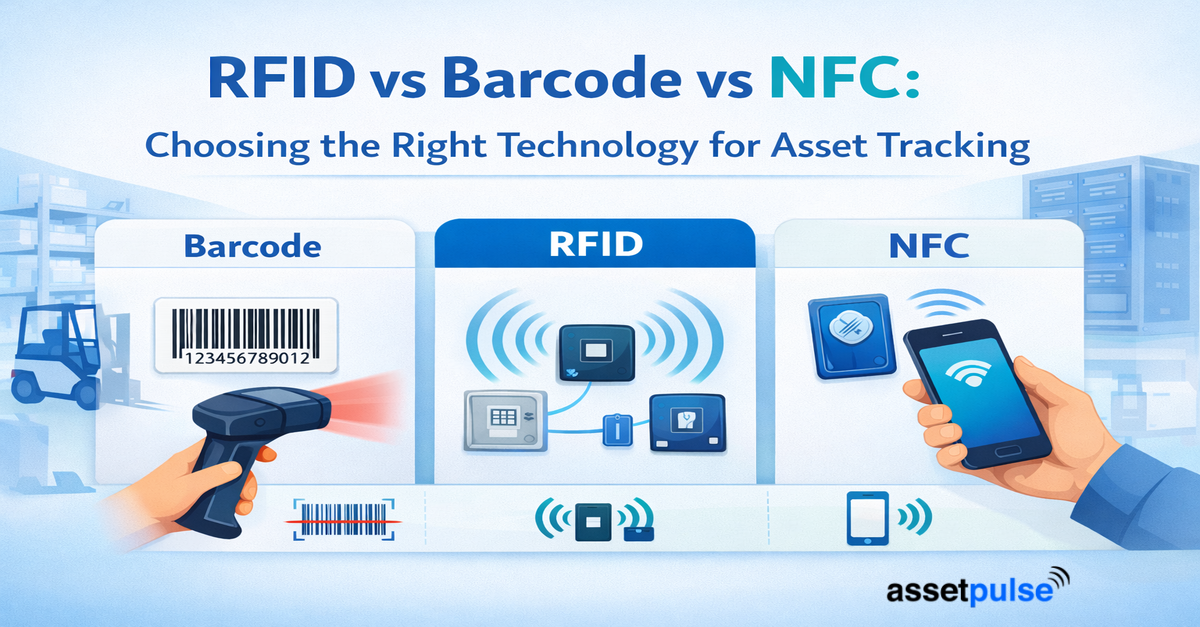

You’re looking at asset tracking technologies and trying to figure out which one actually works for your operation. RFID, barcodes, and NFC all promise to help you track equipment and inventory more efficiently. The catch? They work in completely different ways, and picking the wrong one can waste time and money.
This guide breaks down RFID vs Barcode vs NFC, explaining how each technology operates, where it excels, and which scenarios favor one over the others.
What are Barcodes?
Barcodes display information in a way that’s easy for scanners to ‘see’ and capture instantly. Traditional barcodes use vertical lines of different widths and spacing to encode information. These linear barcodes work through a simple process: scanners emit light that the black bars absorb while white spaces reflect it back. The scanner measures these reflections and turns the pattern into digital data.
Two-dimensional barcodes came along later, using patterns of squares, dots, or hexagons arranged in grids. QR codes are the most familiar example, though they’re not the only type. Despite ditching the traditional bars, these still count as barcodes.
Most linear barcodes show numbers below the bars. The first digit usually indicates product type. The next five identify the manufacturer. Another five specify the individual product. The final digit checks that the scanner reads everything correctly.
The technology measures reflected light. Scanners turn this measurement into binary data—black bars become ones; white spaces become zeros. This binary string pulls up corresponding information from your database.
What is NFC?
NFC stands for Near Field Communication. This wireless tech lets two devices swap data when you bring them within a few centimeters of each other. NFC runs at 13.56 MHz and evolved from high-frequency RFID.
Unlike passive barcodes that just store information, NFC supports two-way communication. Your smartphone can both read data from NFC tags and write information to them. This bidirectional setup opens possibilities beyond simple identification.
You see NFC most often in contactless payments. When you tap your phone or card at a payment terminal, NFC handles the transaction. The same tech powers access control systems, transit cards, and digital business cards.
NFC tags come in different formats—stickers, cards, key fobs, even implantable chips. These tags can be read-only, storing fixed information, or read-write, letting you update data in the field.
NFC’s very short read range can be a drawback in some cases, but it actually makes certain uses more secure. Payment terminals must be very close to complete transactions, cutting the risk of unauthorized reads. This same trait makes NFC impractical when you need to scan from a distance.
How RFID Works
RFID uses radio frequency waves to identify and track objects automatically. An RFID system needs three parts: tags attached to your assets, readers that communicate with those tags, and software that processes the collected data.
RFID tags have a microchip that stores data and an antenna that sends and receives radio signals. When an RFID reader broadcasts radio waves, tags within range pick up this energy. Passive RFID tags use that captured energy to power their circuits and send back the information in their chips. Active RFID tags have their own battery, letting them broadcast signals over much longer distances.
The reader picks up the signals that the tags send. This happens without needing any line of sight between the reader and the tag. The tag can be inside a box, behind a metal surface, or move along a conveyor belt—as long as radio waves can reach it, the tag responds.
RFID systems run at different frequencies. Low-frequency systems work well near metal and water. High-frequency systems balance range and performance. Ultra-high-frequency systems, the most common for asset tracking, can read tags from 30 feet or more and process hundreds of tags per second.
Not Sure Which Technology Fits Your Asset Tracking Needs?
Get Expert Guidance
Schedule a Free ConsultationRFID vs Barcode vs NFC – Comparing These Technologies
Do You Need Line of Sight?
Barcodes need complete visibility. The scanner has to see the entire barcode clearly. Dirt, scratches, bad lighting, or wrong orientation stops successful scans. A barcode on the back of a box means someone needs to turn that box around. Labels that fade or peel become useless.
NFC also needs close proximity, though not true line of sight. The reader and tag must be within a few centimeters. Physical barriers don’t completely stop NFC reads the way they block barcode scans, but the effective range stays extremely limited.
RFID gets rid of line-of-sight requirements entirely. Tags respond to readers through cardboard, plastic, wood, and even some metals when configured properly. You can scan a pallet of tagged items without unpacking anything. Equipment stored in cabinets gets inventoried without opening doors.

How Fast Can You Scan?
Barcode scanners read one code at a time. Each scan needs positioning the scanner, aiming at the barcode, and waiting for confirmation. Even experienced people rarely get past 30 to 50 scans per minute under ideal conditions.
NFC works similarly—one tag at a time. The tap-and-read motion feels quick for payments or check-ins, but scaling this to hundreds or thousands of items becomes impractical.
RFID changes this completely. A single RFID reader grabs hundreds of tag responses per second. Walking past a storage area with a handheld reader registers every tagged item in range. Portal systems at doorways automatically log everything passing through. This speed advantage compounds when you’re managing thousands of assets.
What’s the Read Range?
Barcode scanners work from a few inches away. Specialized long-range scanners might hit 10 to 15 feet, but only under perfect conditions with large, high-quality codes.
NFC’s defining feature is its extremely short range—typically 4 centimeters or less. In some applications, this is actually a benefit rather than a limitation, but it still severely restricts what you can do.
RFID read ranges vary by tag type and frequency. Passive UHF tags commonly read from 10 to 30 feet. Active tags can reach several hundred feet. This range flexibility lets you design systems matching your space requirements.
What Can They Store?
Traditional barcodes store limited information—typically just enough to look up an item in a database. Some two-dimensional codes hold more data, but they’re fundamentally read-only. Once printed, the information can’t change.
NFC tags typically store between 48 bytes and 4 kilobytes of data. More importantly, most NFC tags support read-write operations. You can encode information onto tags in the field, update maintenance records, or log usage history directly to the tag.
RFID tags span the widest range. Basic tags store only an identification number. Advanced tags provide several kilobytes of memory. Like NFC, you can write to RFID tags, letting you update data throughout an asset’s lifecycle. RFID also supports encryption and authentication that makes tags hard to clone or fake.
How Durable are They?
Barcodes fail easily in harsh conditions. Outdoor exposure fades ink. Abrasion removes print from labels. Chemical exposure dissolves adhesive. Moisture makes paper disintegrate. These vulnerabilities make barcodes unsuitable for construction sites, oil fields, or industrial plants.
NFC tags, typically embedded in plastic or other protective materials, handle environmental challenges better than barcodes. They resist moisture and moderate temperature swings. However, the close reading range means handlers still need direct access to the tag location, which may not work in dirty or hazardous conditions.
RFID tags designed for industrial use survive remarkable abuse. Tags in rugged housings withstand extreme temperatures, chemical exposure, pressure washing, and years of outdoor weathering. On-metal tags work reliably when bolted to steel equipment. These environmental capabilities extend RFID to scenarios where labels simply can’t survive.
Need Help Choosing the Right Technology?
Talk to Our Experts to Find the Best Fit
Get Free ConsultationRFID vs Barcode vs NFC – When to Choose Each Technology
Barcode Applications
Barcodes work well when budget severely limits technology investment. Small retail operations, basic warehouses with controlled environments, and applications needing minimal equipment benefit from barcode simplicity.
Low-volume operations where staff can scan items individually without time pressure make good barcode candidates. If your team scans 50 items per day rather than 5,000, barcode speed limitations won’t create bottlenecks.
Controlled indoor environments where labels stay clean and visible extend barcode viability. Climate-controlled warehouses, retail stockrooms, and office equipment tracking can function adequately with barcodes.
NFC Applications
NFC excels at secure, close-range interactions. Payment systems use NFC’s short range as a security feature. Access control benefits from NFC’s two-way communication—a single tag can both identify a person and log entry times.
Consumer-facing applications where smartphone integration matters favor NFC. Museums use NFC tags to deliver content to visitors’ phones. Products with NFC tags provide authentication and detailed information to customers.
Small-scale asset tracking where each item gets individual attention works with NFC. High-value items needing careful handling—jewelry, pharmaceuticals, or precision instruments—can be tracked effectively with NFC if volumes stay manageable.
RFID Applications
RFID becomes essential when operations need bulk scanning. Warehouses receiving hundreds of pallets daily, manufacturers tracking thousands of work-in-progress items, or hospitals managing large medical equipment inventories need RFID’s speed.
Harsh environments demand RFID’s durability. Construction equipment exposed to weather, tools used in chemical plants, or assets stored outdoors require tags that survive conditions destroying barcodes.
Real-time location tracking applications, knowing immediately when assets move between zones, requires RFID’s automated reading. Portal systems monitor movement without human intervention, providing continuous visibility that barcodes and NFC can’t match.
Operations where line-of-sight scanning creates inefficiencies favor RFID. Dense storage where items stack deeply, packaged goods that would require unpacking to scan labels, or equipment installed in hard-to-reach locations all become candidates for RFID.
While comparing RFID, barcode, and NFC is a great starting point, you may also want to see how QR codes fit into the mix. Explore this RFID vs Barcode vs NFC vs QR code comparison to clearly understand which technology fits your needs best.
Making Your Decision
Organizations often use multiple technologies, picking each where it provides the best balance of capability and cost. An enterprise might use barcodes for basic shelf locations, RFID for tracking valuable equipment and inventory, and NFC for employee access badges.
Think about your operational needs carefully. How many items need tracking? How frequently do you scan them? What environmental conditions do tags face? What level of automation would benefit your workflows? How much can you invest upfront versus ongoing operational costs?
The technology landscape keeps changing. RFID costs drop as adoption grows and manufacturing scales. NFC capabilities expand as smartphone penetration increases. Yet the fundamental traits of each technology—barcodes’ simplicity, NFC’s secure short-range communication, and RFID’s automated bulk reading—stay distinct.
Your asset tracking technology choice ultimately depends on matching these traits to your specific operational challenges and goals. Understanding what each technology does best positions your organization to make informed choices that improve efficiency while controlling costs.
AssetPulse is a leader in best-in-class IoT asset-tracking solutions, helping organizations across laboratories, cleanrooms, healthcare, hi-tech R&D, manufacturing, construction, oil & gas, and IT achieve real-time visibility into assets. With its AssetGather software suite, covering server, handheld, and smartphone platforms, the company delivers end-to-end asset tracking systems that eliminate manual processes and reduce asset loss. From indoor and outdoor tracking to check-in/check-out, rapid inventory, and work-in-progress monitoring, AssetPulse has been empowering businesses with smarter asset management since 2006.


