
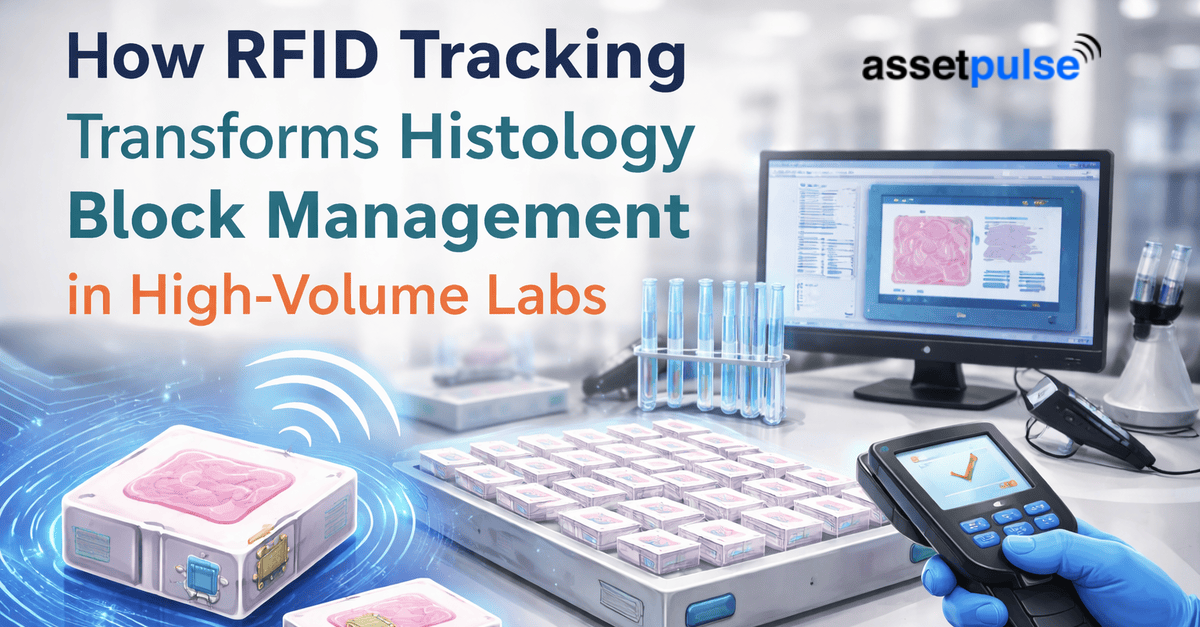

A surgeon calls requesting urgent recuts from a three-year-old biopsy block for a critical patient decision. Your technician searches through rows of paraffin blocks in the archive. Thirty minutes pass. The block remains missing. Treatment decisions get delayed.
If you’re managing histopathology laboratory operations or coordinating tissue biobank collections, you’ve experienced this frustration. Traditional manual tracking methods cannot keep pace with modern diagnostic demands.
Looking to avoid delayed case decisions?
Discover how RFID enables instant histology block location
Get Free ConsultationThe Growing Crisis in Histology Block Management
Pathology labs face mounting pressure from increasing patient volumes and expanding regulatory requirements. Yet specimen tracking systems remain stuck in the past. Most labs still rely on handwritten logs, paper ledgers, and memory to manage thousands of formalin-fixed paraffin-embedded (FFPE) blocks.
When Volume Overwhelms Manual Systems
High-volume labs processing thousands of specimens daily generate massive numbers of tissue blocks annually. Each surgical pathology block must be tracked for years. Therefore, your archive grows continuously.
Most labs use stacked metal trays, alphabetical filing systems, or basic cabinet storage. Technicians spend considerable time searching for specific blocks, representing significant labor that could support patient care instead.
The Real Risks: Misidentification and Lost Chain of Custody
Patient identification errors in anatomic pathology occur at a measurable rate that is clinically significant, even in well run laboratories, and can lead to serious consequences if not addressed. Even minor identification errors cascade into major problems. A mislabeled block can result in incorrect diagnosis, inappropriate treatment, or missed cancer detection.
Beyond labeling errors, tissue blocks move constantly through the lab—from grossing stations to embedding centers, from storage archives to cutting rooms, from local labs to reference centers. Traditional paper logs cannot track these movements reliably.
When blocks leave for outside consultation or research projects, the audit trail often breaks completely. Labs struggle to answer basic questions: Where is this block now? Who handled it last? When did it leave our facility?
Concerned about chain of custody risks?
Learn how RFID ensures complete specimen traceability
Get Free ConsultationWhy Traditional Methods Fail
Barcode systems require line-of-sight scanning. A technician must locate each block physically, pick it up, orient the label correctly, and scan it individually. This process breaks down with thousands of blocks. Additionally, if technicians forget to scan samples at each stage, tracking information won’t be recorded.
Spreadsheet inventories quickly become outdated. Staff must remember to log every movement. Entries get skipped during busy periods. Within months, the spreadsheet diverges significantly from reality. Manual logbooks offer no search capability. Finding a specific block from a few years ago means flipping through pages of handwritten entries.
These legacy methods depend entirely on human memory and manual effort. In high-volume labs, this approach cannot scale.
RFID Technology: A Proven Solution to Track Histology Blocks
Radio frequency identification technology offers pathology labs a path from reactive crisis management to proactive specimen control. Unlike barcodes that need direct line-of-sight, RFID enables automatic tracking of histology blocks throughout their entire lifecycle.
Specialized Tags Built for Histology
Tissue cassettes get embedded in hot liquid paraffin at temperatures around 60-65°C. Standard RFID tags would fail instantly under these conditions. Specialized RFID tags use materials rated for high-temperature exposure. Labs affix the tag to the cassette before embedding. When paraffin pours over the tag, it remains fully functional and stays readable through the paraffin wax for the block’s entire retention period.
Automatic Tracking Throughout Your Lab
RFID readers installed at key points create automatic tracking zones. When a cassette enters grossing, an overhead reader captures its unique identifier and logs the exact time and location without any staff action required. As histology blocks move to embedding stations, cutting areas, or storage archives, readers at each location update their status automatically.
Laboratory directors can locate any specific histology block instantly through the tracking software. Search by patient name, accession number, tissue type, or procedure date. The system shows the block’s current location and complete movement history within seconds.
When urgent cases arrive, instead of searching manually, your technician queries the system, walks directly to the correct storage location, and retrieves the histology block in under two minutes. Treatment decisions proceed without delay.
Looking for real-time visibility into histology blocks?
See how RFID tracks blocks automatically across workflows
Get Free ConsultationReal-Time Inventory and Complete Documentation
RFID enables real-time inventory visibility. The system maintains an accurate count of every histology block in every location continuously. Periodic validation becomes simple—a technician walks through the archive with a handheld RFID reader that captures hundreds of blocks per minute. The software compares scanned blocks against the database and flags any discrepancies immediately.
Every RFID scan creates a permanent digital record. The system logs which block moved, when it moved, where it went, and which staff member handled it. This detailed audit trail satisfies regulatory requirements automatically. For research projects using archived tissue blocks, institutional review boards receive the detailed tracking they require without creating additional paperwork burden for lab staff.
Seamless Integration with Laboratory Information Systems
Modern RFID tracking systems connect directly to anatomical pathology laboratory information systems (APLIS). When accessioning creates a new case, the APLIS generates unique identifiers that get encoded onto RFID tags printed for each tissue cassette. Information flows automatically between systems—both staying synchronized without manual intervention.
Pathologists viewing cases digitally can see exactly where corresponding blocks reside. Technicians pulling blocks for recuts have instant access to case history and special instructions. Everyone works from the same real-time information.
Understanding the Investment
While implementing RFID requires upfront investment in hardware, software platforms, and system integration, organizations typically see positive return on investment within 18 months to 3 years. The exact timeframe depends on laboratory volume and specific workflow challenges being addressed.
Benefits offsetting these costs include reduced labor for specimen searches, decreased error-related costs, improved inventory accuracy, enhanced regulatory compliance, and better utilization of valuable pathology staff time.
Implementing RFID Successfully
Successful RFID deployment starts with understanding your specific workflow. Choose RFID tags rated explicitly for high-temperature paraffin embedding with specifications including exposure to 65°C minimum. Application happens at the grossing station, where staff affix tags to cassettes during specimen processing—adding mere seconds to existing processes.
Install fixed RFID readers at critical tracking points: grossing stations, embedding centers, microtome areas, and all storage locations. Handheld readers supplement fixed infrastructure for targeted searches and periodic inventory audits.
Technology succeeds only when staff embrace it. Pathology technicians need hands-on training that demonstrates immediate benefits. Most staff adapt quickly once they see the system preventing the frustrations they experience daily.
Ready to modernize histology block tracking?
Discover how RFID transforms specimen management in labs
Get Free ConsultationTaking the Next Step
The transition to RFID-enabled histology block management represents a fundamental shift from reactive problem-solving to proactive specimen control. Your pathology lab deserves tools that eliminate frustrating searches and enable staff to focus on diagnostic excellence rather than archive logistics.
Today’s patients need confidence that their tissue specimens remain secure, accessible, and properly managed. RFID technology delivers this assurance while streamlining operations and improving safety outcomes.
Contact AssetPulse for a free consultation to explore how RFID-enabled histology block tracking can transform your operations. Discover how leading pathology labs are using automated tracking to reduce errors, save time, and enhance patient care. Your patients, pathologists, and laboratory staff will all benefit from this critical investment in specimen management quality.


