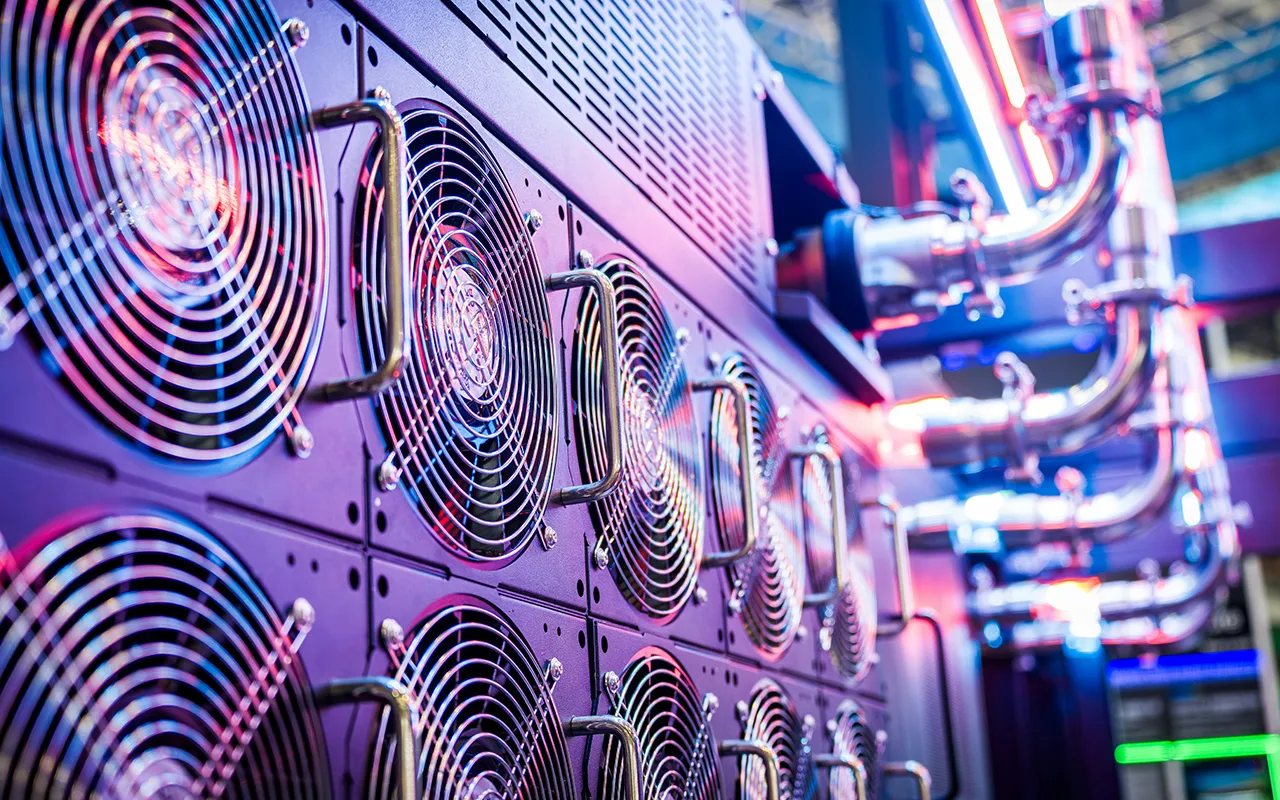
Data centers fall into seven main types. They are enterprise, colocation, hyperscale, edge, cloud, neocloud, and government/sovereign. Data centers are classified primarily by who owns the facility and who it serves. A separate classification, the Uptime Institute's Tier I through Tier IV system, rates a facility's redundancy and uptime guarantees independent of its ownership type. Many real facilities combine more than one category at once.
The Seven Types of Data Centers
Facility type is really a question of ownership and audience: who built it, who runs it day to day, and who it exists to serve. Here's what separates each category in practice.
Enterprise Data Centers
An enterprise data center is privately owned and operated by a single organization for its own internal IT needs. For example, a bank running its core transaction systems, a hospital network hosting its electronic health records, or a manufacturer running its ERP and plant-control systems. The defining trait is single-tenant, single-purpose ownership: the organization controls the entire facility, sets its own security and compliance policies, and bears the full capital cost of building and maintaining it. Because there's only one tenant, asset ownership and accountability are usually clear-cut. The tracking challenge is scale and change velocity, not multi-tenant complexity.
Colocation Data Centers
A colocation (colo) facility is built and operated by a third-party provider that leases rack, cage, or suite space to many separate customers. Equinix, Digital Realty, CyrusOne, and QTS are well-known examples. Colocation splits further into retail colocation (smaller customers leasing individual racks or cages) and wholesale colocation (large customers leasing entire suites or buildings). The provider typically owns and maintains the shell, power, and cooling infrastructure, while each tenant owns and manages its own equipment inside its leased space. That split of responsibility is exactly what makes colocation asset tracking harder than enterprise tracking. Multiple organizations' equipment sits in physically adjacent or overlapping spaces, and nobody outside a tenant's own team has full visibility into that tenant's assets unless a tracking system is deliberately extended to cover it.
Hyperscale Data Centers
Hyperscale facilities are the massive, modular campuses owned or leased by the largest cloud providers. AWS, Microsoft Azure, Google Cloud, and Meta are the most commonly cited examples, and they form the physical backbone of cloud regions and availability zones. A single hyperscale campus can span multiple buildings and hundreds of megawatts of capacity, built using standardized, repeatable designs so new capacity can be added quickly. Scale is the defining challenge here. Asset tracking has to work across enormous, homogenous equipment populations rather than a handful of distinct racks.
Edge Data Centers
Edge facilities are small, decentralized sites placed close to end users or data sources to cut latency, anywhere from a single rack to roughly fifty, often in a micro or modular/containerized format. Because edge sites are numerous, geographically scattered, and frequently unstaffed, they invert the usual asset-tracking problem: instead of tracking a lot of equipment in one place, organizations need to track a little equipment in a lot of places, often without on-site personnel to do a manual check.
Cloud Data Centers
“Cloud data center” describes any facility, hyperscaler-owned or leased, that delivers on-demand, subscription-based compute and storage. It's a workload-and-delivery-model label more than a distinct physical category, and in practice it overlaps heavily with hyperscale and, increasingly, neocloud facilities.
Neoclouds
Neoclouds are a newer, AI-specialized category: providers offering GPU-as-a-service infrastructure purpose-built for AI training and inference, distinct from the general-purpose compute that traditional hyperscalers sell. Because neocloud facilities are built almost entirely around dense GPU clusters, they tend to skew heavily toward the AI-optimized construction and liquid-cooling approach. Both trends — the shift toward AI-optimized construction and the underlying demand driving it — are covered in more depth in why AI is fueling the data center boom and what a data center really costs to build.
Government / Sovereign Data Centers
These facilities are operated for public-sector or national-security workloads, and the category is growing quickly as “sovereign AI” initiatives push governments to build and control their own AI infrastructure rather than lease it commercially. Compliance and access-control requirements here are typically stricter than in any other category, which raises the stakes on accurate, auditable asset records.
Data Center Tiers: Tier I Through Tier IV
Facility type tells you who owns and uses a data center. Tier level, defined by the Uptime Institute, tells you something different: how much redundancy it has and how much downtime you should expect. Any facility type, enterprise, colocation, or hyperscale, can be built to any tier level.
| Tier | Redundancy | Typical Availability | |
|---|---|---|---|
| 1 | Tier I | Single path for power and cooling, no redundancy | ~99.671% (about 28.8 hours of downtime/year) |
| 2 | Tier II | Single path with some redundant components | ~99.741% (about 22 hours of downtime/year) |
| 3 | Tier III | Multiple power/cooling paths, concurrently maintainable | ~99.982% (about 1.6 hours of downtime/year) |
| 4 | Tier IV | Fully fault-tolerant, redundant paths (2N or higher) | ~99.995% (about 26.3 minutes of downtime/year) |
In practice, most modern colocation and hyperscale facilities target Tier III or above, because the availability commitments customers expect leave little room for single points of failure.
Ownership and Redundancy Compared
| Type | Ownership | Typical Tenant Count | Common Tier Target | |
|---|---|---|---|---|
| 1 | Enterprise | Single organization | 1 (internal) | II–III |
| 2 | Colocation | Third-party provider | Many (multi-tenant) | III–IV |
| 3 | Hyperscale | Cloud provider (owned or leased) | 1 operator, many internal workloads | III–IV |
| 4 | Edge | Varies by provider, operator, or tenant | 1–2 typically | I–III |
| 5 | Neocloud | AI-specialized provider | Many (GPU-as-a-service tenants) | III–IV |
| 6 | Government/Sovereign | Government or contracted operator | 1 (restricted) | III–IV |
Cloud data centers aren't listed separately in the table above; they typically run on the same hyperscale (and increasingly neocloud) infrastructure shown there.
Choosing the Right Data Center Type: A Decision Framework
For teams evaluating where to run a new workload, the type decision usually comes down to three questions:
- How much control do you need over physical infrastructure? Enterprise and sovereign facilities offer the most control; hyperscale and cloud offer the least (in exchange for not having to manage it).
- How latency-sensitive is the workload? Edge facilities exist specifically to solve latency; centralized enterprise or hyperscale facilities are fine for workloads that tolerate more distance.
- How specialized is the compute? AI training and inference at scale increasingly point toward neocloud or AI-optimized hyperscale capacity rather than general-purpose enterprise infrastructure.
Why Facility Type Changes How You Track Assets
The classification isn't just academic; it directly shapes the asset-tracking problem. A single-tenant enterprise facility has one owner and one asset register to maintain. A colocation facility has multiple tenants whose equipment must be tracked separately, often without full visibility into a neighboring tenant's assets. A hyperscale campus has to track equipment at a scale where manual processes break down almost immediately. An edge deployment has to track equipment across dozens or hundreds of unstaffed sites. AssetPulse's complete guide to data center asset tracking covers the technology choices that fit each of these scenarios: RFID, BLE, barcode, and IoT. Readers managing multi-tenant environments specifically may also want AssetPulse's IT and data center asset tracking solutions built for exactly that complexity.