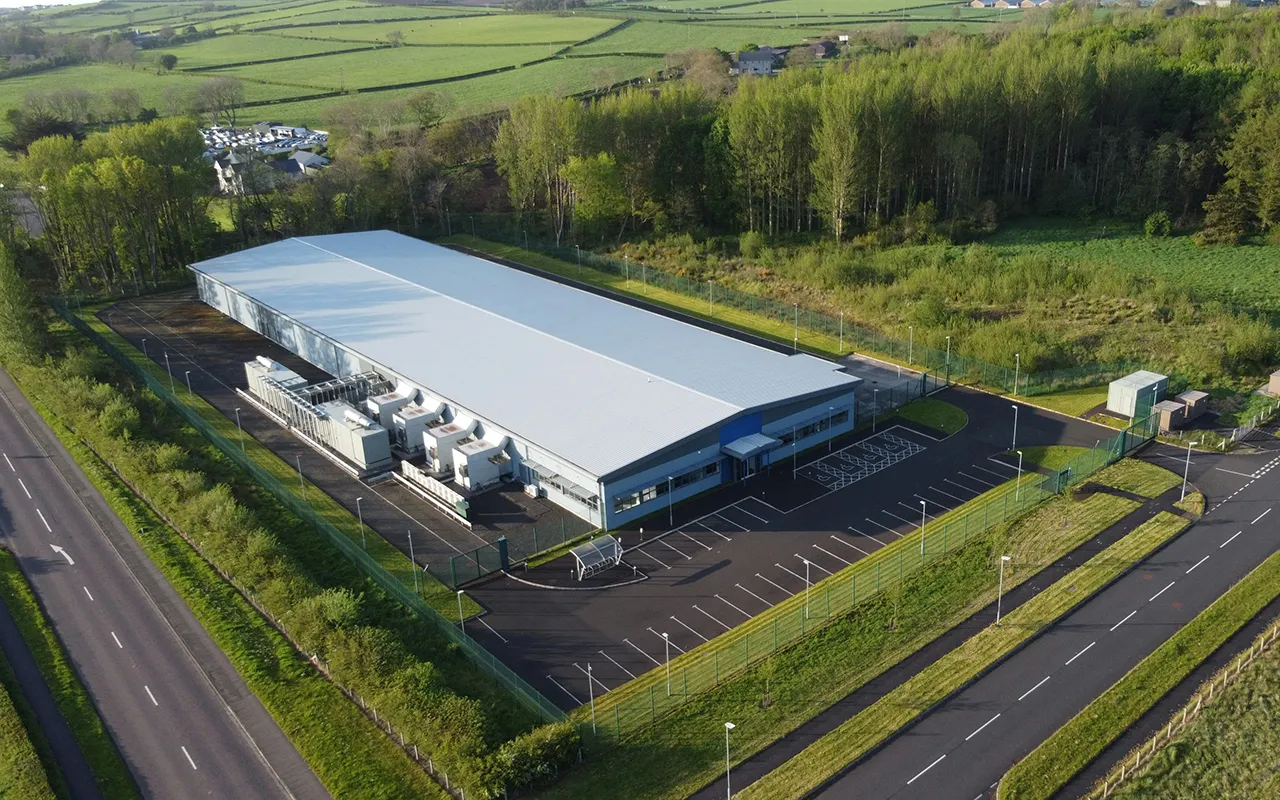
AI is fueling the data center boom because training and running large models requires far more computing capacity than previous cloud workloads, and hyperscalers are responding with hundreds of billions of dollars in new capacity every year. Global data center capacity is projected to nearly double by 2030, with AI expected to account for roughly half of it, but the pace of that growth is limited less by demand than by how fast power grids and construction crews can keep up.
The Numbers Behind the Headlines
It's easy to treat “AI is driving data center growth” as a vague talking point. The underlying figures are specific enough to plan around. Global data center capacity is projected to grow from roughly 103 gigawatts today to about 200 gigawatts by 2030. In the U.S. specifically, AI data center capacity is forecast to rise from 8.2 gigawatts in 2026 to 21.4 gigawatts by 2031, more than double the country in second place, China.
A newer and faster-growing slice of that total is sovereign and government AI capacity, which is projected to nearly triple, from about 1.3 gigawatts in 2026 to 3.1 gigawatts by 2031, as national governments build out AI infrastructure they control directly rather than lease from commercial hyperscalers. That's a meaningful shift: it means data center growth isn't just a commercial cloud story anymore, it's increasingly a national infrastructure story. Government and sovereign facilities are their own distinct category — see our guide to data center types for how they compare to commercial hyperscale and colocation.
Training vs. Inference: The Workload Shift Behind Distributed Buildout
A lot of the “why so many new facilities” question comes down to a shift inside AI workloads themselves. In 2025, AI represented roughly a quarter of overall data center workloads, and most of that was training, the process of building a model in the first place, which tends to happen in a small number of very large, centralized facilities.
By 2027, inference, actually running a trained model to answer a question, generate an image, or power an application, is expected to overtake training as the dominant AI workload. Inference is far more latency-sensitive than training: a model that takes an extra 200 milliseconds to respond because the nearest data center is 1,000 miles away is a worse product. That pushes capacity outward, toward more numerous, smaller, geographically distributed facilities rather than a handful of enormous training campuses. It's one of the more counterintuitive parts of the boom: growth in facility count is partly a latency problem, not just a raw compute problem.
The Hyperscaler Capex Supercycle
The dollar figures behind this buildout are large enough that they've become a recurring line item in hyperscaler earnings calls. Microsoft, Amazon, Alphabet, and Meta are expected to spend more than $700 billion in capital expenditures in 2026, driven largely by investments in AI infrastructure, data centers, and computing capacity. Industry watchers have started calling the broader effort the largest peacetime infrastructure project in history, with global data center capital expenditure projected to reach $3–$4 trillion by 2030.
The Stargate Project
The clearest single example of this capex supercycle is the Stargate Project, a joint venture involving OpenAI, Oracle, SoftBank, and MGX targeting roughly $500 billion in investment and about 10 gigawatts of new AI data center capacity. A single project of that scale, on its own, is larger than many countries' entire existing data center footprints, which is a useful way to explain the magnitude of this cycle to someone who hasn't seen the underlying numbers. Put in construction terms, that capital converts into physical build-out at roughly $10–37 million or more per megawatt — see what a data center really costs to build for the full breakdown.
Construction Is Racing to Keep Up
Capital commitments only turn into capacity once something gets built, and construction activity has moved almost as fast as the spending commitments. U.S. data center construction starts hit $77.7 billion in 2025, up 188.8% year-over-year, and are on pace to roughly double again in 2026. That kind of growth rate strains everything downstream of it, skilled labor, specialized electrical and cooling contractors, and the equipment supply chain that fits out a shell once it's built.
The Real Bottleneck Is Power, Not Demand
If there's one thing worth correcting in how this boom gets discussed publicly, it's this: the constraint isn't whether hyperscalers want more capacity. It's whether the power grid can deliver it. Roughly 30-50% of planned 2026 AI data center capacity is projected to slip to 2028 because of power grid interconnection delays, the process of physically connecting a new facility to the grid and getting utilities to commit the generation capacity to serve it.
The U.S. Department of Energy projects the grid needs about 100 gigawatts of new capacity by 2030, with data centers responsible for roughly half of that new demand. That's not a data center statistic so much as a national energy-planning statistic, and it explains why so much recent data center site selection has shifted toward regions with available power and grid interconnection capacity, sometimes ahead of considerations like proximity to major population centers.
The GPU and Memory Supply Squeeze
Even where power and permitting aren't the constraint, equipment can be. AI data center spending is consuming roughly 70% of global memory chip production in 2026, which is driving component shortages that ripple into every facility trying to buy GPUs, high-bandwidth memory, and networking gear at the same time. For facilities teams, this has a practical consequence beyond the headline: when replacement components are scarce and lead times stretch out, knowing exactly what equipment you already have, rather than assuming you can quickly buy more, becomes more valuable, not less.
What the Boom Means for Facilities Teams
Put together, these four forces, the training-to-inference shift, the hyperscaler capex supercycle, the power/grid bottleneck, and the component supply squeeze, point to the same practical outcome: more facilities, built faster, packed with denser and harder-to-replace equipment than the previous generation. That combination is exactly why physical asset visibility is becoming a bigger operational concern across the industry, not a smaller one. A full breakdown of what's actually inside these facilities, and how organizations are tracking it, is covered in AssetPulse's complete guide to data center asset tracking.