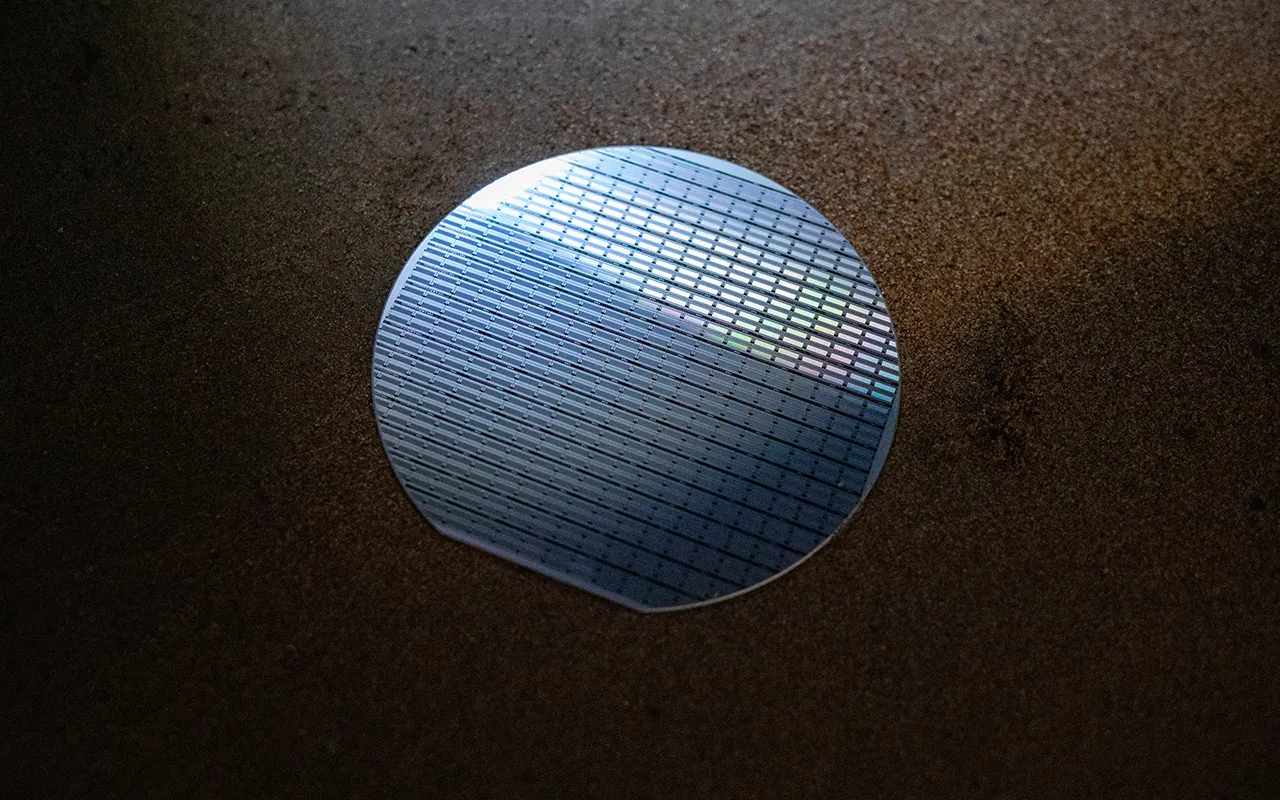
Semiconductor fabs have tracked wafer lots with barcode and QR code stickers for decades. That's changing. Automated material handling systems need to read lot identification without a line-of-sight scan, and barcode labels can't do that reliably at production speed. RFID-enabled wafer lot stickers solve the problem, and adoption is accelerating across the industry.
This article looks at why fabs are shifting to RFID for wafer lot tracking, what's driving the change, and what it takes to turn an RFID-tagged wafer lot into a system that catches routing errors before they cost a production run.
What Is Wafer Lot Tracking?
Wafer lot tracking is the process of identifying and following a group of wafers, a lot, through every step of fabrication. Each lot carries a sticker or label with a unique identifier. As the lot moves from photolithography to etching to deposition and beyond, that identifier is scanned or read at each step, so the fab knows exactly where the lot is, what's been done to it, and where it's supposed to go next.
Historically, that identifier has been a barcode or QR code. A technician or an automated system scans the label at each process step, and the result is logged against the lot record.
Why Barcode Tracking Is Running Into Limits
Barcode and QR code stickers require line-of-sight scanning. That's a reasonable requirement on a factory floor with manual handling. It's a much bigger constraint on an automated material handling system (AMHS) moving wafer lots between tools without a person present.
An AMHS carrier has to be positioned precisely enough for a camera or scanner to read the label. Any misalignment, glare, or obstruction breaks the read. At the process-step volumes modern fabs run, that failure rate adds up to delays and manual intervention. This was exactly what automation was supposed to eliminate.
Why RFID Is Replacing Barcodes for Wafer Lots
RFID tags solve the line-of-sight problem. A reader can identify a wafer lot's tag as the carrier passes through a zone, without needing a clean visual angle. That fits how AMHS actually moves material: continuously, through doorways, load ports, and process-tool interfaces, without stopping for a scan.
Industry market estimates put RFID-enabled stickers at roughly 15-20% of wafer lot tracking unit demand in 2024, projected to reach 25-35% by 2030, as automated material handling becomes standard in new and upgraded fabs.
The shift isn't only about automation. As fabs migrate to 3nm and 2nm process nodes, the number of process steps per wafer lot increases, and industry estimates suggest that pushes sticker and tracking-point consumption up by roughly 10-20% compared to legacy nodes. More steps mean more scan points, and more scan points mean more opportunities for a line-of-sight failure to slow the line down. RFID removes that failure mode at each additional touchpoint.
Barcode vs. RFID for Wafer Lot Tracking at a Glance
| Factor | Barcode / QR Sticker | RFID Sticker | |
|---|---|---|---|
| 1 | Scanning requirement | Line-of-sight | No line-of-sight needed |
| 2 | Fit for automated material handling | Limited - alignment sensitive | Built for continuous automated reads |
| 3 | Approx. share of unit demand, 2024 | ~80-85% | ~15-20% |
| 4 | Projected share by 2030 | Declining | ~25-35% |
| 5 | Typical unit cost | Lower | Higher |
What an RFID-Tagged Wafer Lot Actually Needs to Work
Tagging the lot is only half the system. An RFID sticker on its own tells you an identifier exists. It doesn't tell you where that lot is right now, whether it's in the correct process sequence, or whether it just entered a zone it shouldn't be in.
That's the job of fixed readers positioned at zone transitions: cleanroom entry points, load ports, and process-tool interfaces, combined with software that interprets each read in context. When a lot's tag is read entering the wrong process zone, the system needs to flag that immediately, before the process step runs and before yield is affected. That's a routing check, not just a location log, and it depends on readers and software working together with the tag, not on the tag alone.
This is what AssetGather's WIP Visibility capability does, paired with Routing & Sequence Enforcement, alerting operators the moment a lot arrives at the wrong station or skips a required step. Fixed readers at zone transitions capture every lot movement automatically, and the platform flags routing errors at the point of entry, before the wrong process step runs, not after a deviation investigation finds it.
Material Requirements Don't Disappear With RFID
Switching from barcode to RFID doesn't remove the cleanroom compatibility requirements a wafer lot sticker has to meet. RFID variants still need to be low-outgassing, resistant to cleanroom chemicals, and meet low particle-shedding standards. It is the same baseline any cleanroom-compatible RFID tag has to clear, plus a chip and antenna that can survive the same environment.
What This Means for Fabs Evaluating a Tracking Upgrade
Fabs still running barcode-based wafer lot tracking are running into the constraint that's driving the industry-wide switch: line-of-sight scanning doesn't scale with automated material handling, and it doesn't scale with the added process-step count of advanced nodes.
Moving to RFID for wafer lot identification only solves part of the problem, though. The tag has to be paired with reader infrastructure at the transition points that matter, and software that turns a raw read into a routing check rather than just a log entry.
AssetPulse has been deploying RFID and BLE asset tracking in precision manufacturing environments, including semiconductor and electronics fabs, since 2005, combining tags, readers, and software into one deployment instead of requiring a fab to integrate separate vendors for each piece. If your fab is evaluating that shift, talk to an AssetPulse RFID specialist about what a zone-by-zone deployment would look like on your floor.