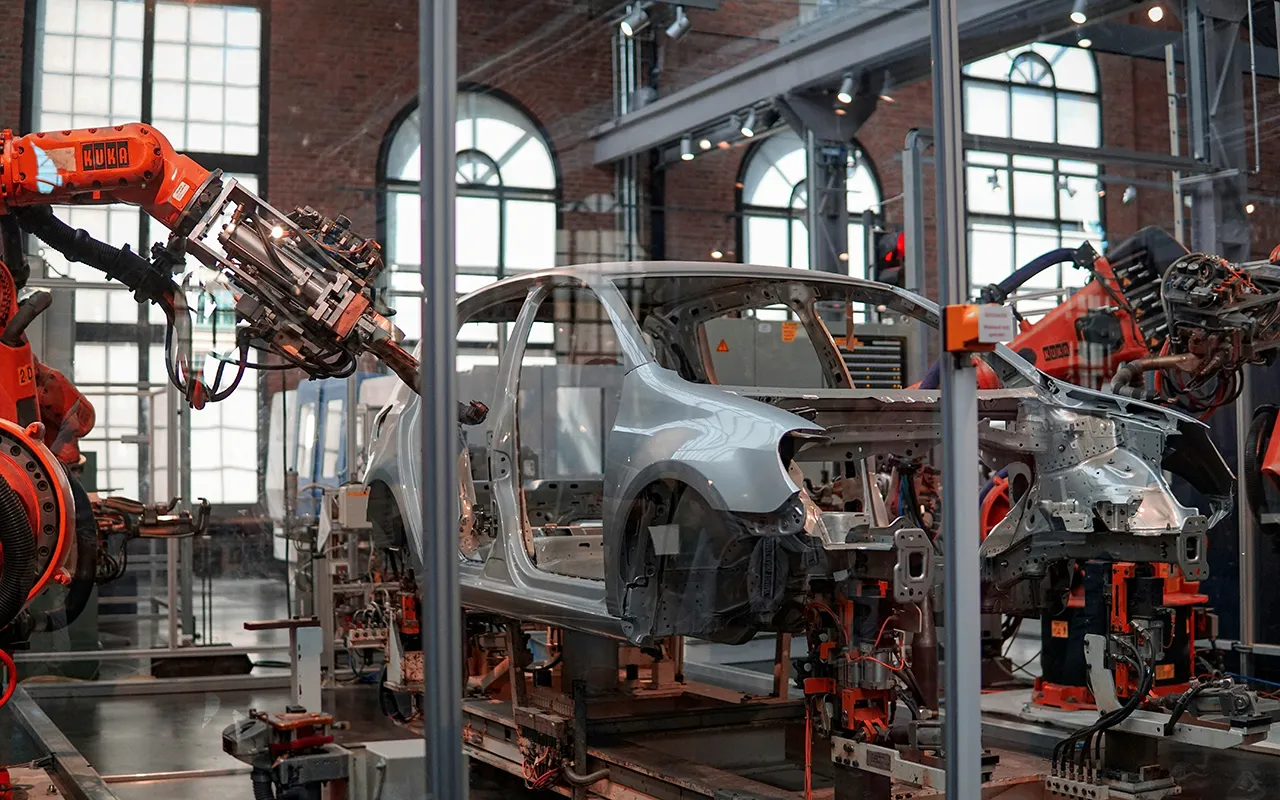
RFID work-in-progress tracking gives automotive manufacturers real-time visibility into vehicle and assembly location across the production line. When every unit in process is automatically identified and its position is continuously updated, production managers can eliminate search time, address bottlenecks as they form, and keep line flow synchronized with schedule.
Automotive assembly plants run on tight cycle times. A vehicle body missing from a paint queue, a subassembly waiting at the wrong station, or a unit that sat in a buffer zone longer than planned can cascade into downstream delays that affect throughput for the rest of the shift. The pressure to know where every unit is, and where it should be, is constant.
Manual tracking can't keep pace with that demand. RFID can.
What Does WIP Tracking Actually Mean on the Automotive Shop Floor?
Work-in-progress inventory in automotive manufacturing includes every vehicle body, chassis, powertrain, subassembly, and component set that is somewhere between raw material receipt and finished vehicle delivery. On a high-volume assembly line, that can mean thousands of active units at any moment.
Traditional approaches to WIP visibility rely on barcode scans at defined checkpoints, manual entries by operators, and production sequencing software that assumes parts and assemblies arrive in the expected order. When they don't—and in real production environments, they frequently don't—the gap between what the system shows and what's actually on the floor creates confusion and rework.
RFID eliminates that gap by capturing movement data automatically, without operator intervention, at every relevant point in the process.
How RFID Tags Follow Vehicles and Assemblies Through Production
In automotive applications, RFID readers are typically installed at fixed points along the production line—entry and exit points for major process areas like body shop, paint, trim, and chassis. Vehicles or carriers are tagged at the start of production and the tags stay on through the entire build sequence.
As a vehicle moves through each zone, readers capture the tag automatically and update the vehicle's location record in the tracking system. Production managers see a live view of where every unit is at any moment. They don't need to ask the floor. They don't need to wait for an operator scan.
Buffer Zone and Storage Area Visibility
One of the most valuable aspects of RFID in automotive production is visibility into buffer zones and temporary storage areas. These are the places where vehicles and assemblies wait between operations—and where units can disappear from effective tracking in manual systems.
RFID readers in buffer zones give production schedulers an accurate count of how many units are waiting, which specific units are there, and how long they've been waiting. That data drives better sequencing decisions and earlier alerts when a buffer is draining faster than the upstream operation can refill it.
Sequence Verification Before Assembly Operations
Many automotive assembly operations are sequence-sensitive. The right variant needs to arrive at the right station at the right time. RFID enables automatic sequence verification before a unit enters a critical operation—alerting the operator or stopping the carrier if the wrong variant is approaching a specialized station.
This kind of error prevention is especially relevant in mixed-model production environments, where multiple vehicle configurations run on the same line. RFID confirmation at each station reduces mis-build risk without requiring operators to manually verify build data every cycle.
Where Do Bottlenecks Form and How Does RFID Identify Them?
Production bottlenecks in automotive assembly typically develop at process transition points: the handoff from body shop to paint, from paint to trim, from trim to final assembly. These transitions involve different cycle times, different labor resources, and sometimes different physical locations within a large facility.
RFID data gives operations teams the visibility to see exactly where units are piling up. If 30 vehicles are waiting at the entry to the paint shop while the exit queue is empty, something is wrong upstream or the paint line has slowed. RFID timestamps identify that imbalance in real time, giving managers the data they need to act before the delay compounds.
Over time, that data becomes a baseline for line performance analysis. Historical WIP flow records show where transitions consistently create delays, supporting Lean and continuous improvement projects with objective production data.
Integration with Production Management and MES Systems
RFID WIP tracking generates the most operational value when it feeds into a broader production management or Manufacturing Execution System (MES). The RFID platform serves as the location and identity data layer; the MES uses that data to update work order status, trigger downstream operations, and maintain accurate production records.
For automotive manufacturers running IATF 16949 quality management systems, RFID-integrated production records support traceability requirements for finished vehicles and subassemblies. When a quality issue surfaces after a vehicle ships, WIP location history helps identify which units share production window, line zone, or process characteristics with the suspect vehicle.
What About Returnable Containers and Carriers?
Automotive plants typically use RFID-tagged carriers, racks, and skids to move assemblies through the facility. These assets are themselves tracked items—expensive, often scarce, and critical to production flow. RFID WIP tracking and returnable container tracking often share the same infrastructure, with the system maintaining visibility of both the carrier and the assembly it holds.
When a carrier is empty and returned to a staging area, the system captures that event. Schedulers know which carriers are available and where, reducing the time spent locating empty racks before they're needed back on the line.
About AssetPulse
AssetPulse gives automotive manufacturers real-time visibility into every unit moving through the production line, from body shop through paint, trim, and final assembly. The platform tracks vehicles, subassemblies, and returnable carriers automatically through fixed readers at process transition points, surfaces buffer zone dwell times before bottlenecks compound, and supports sequence verification for mixed-model lines. For plants running IATF 16949 quality systems, AssetPulse's WIP location history feeds directly into traceability documentation, connecting to existing MES and ERP environments so production teams get accurate floor visibility without replacing the systems they already run.