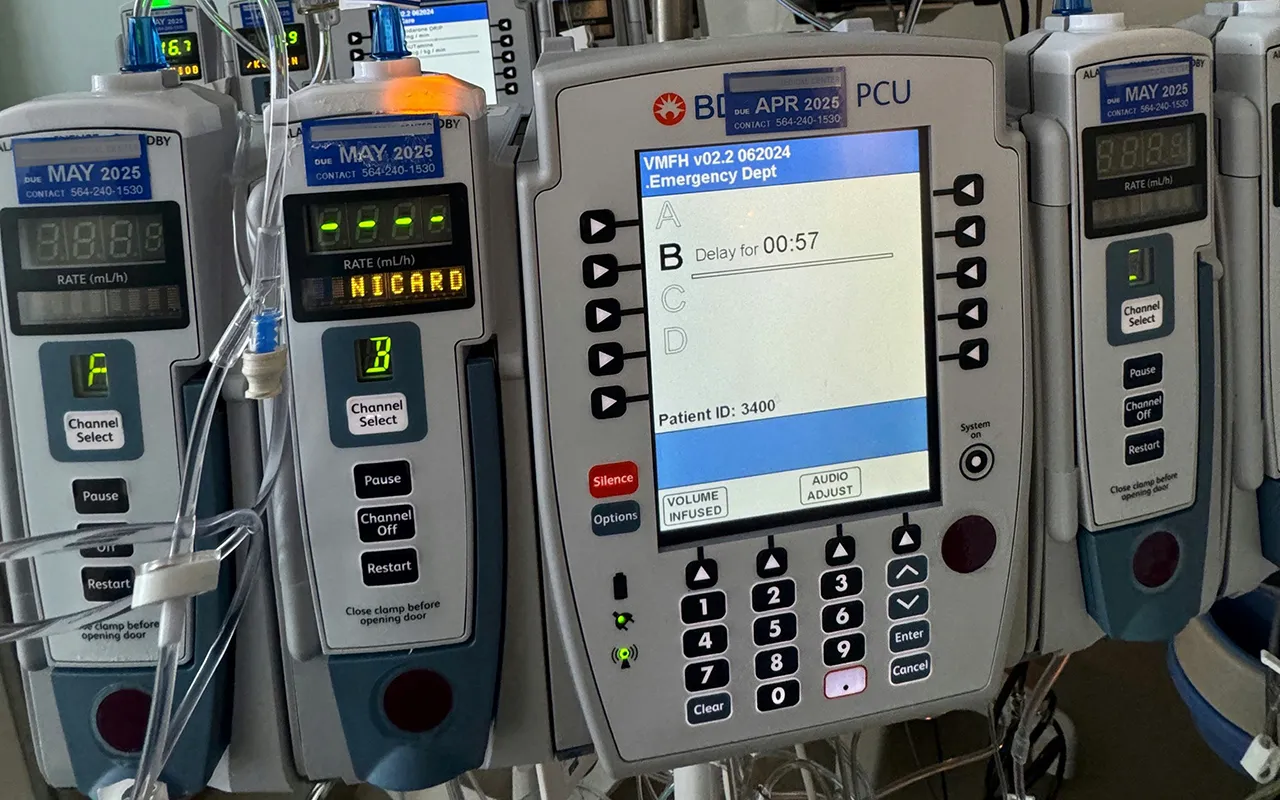
BLE medical equipment tracking uses battery-powered tags and gateways installed throughout a hospital to provide room-level visibility of mobile medical equipment such as infusion pumps, wheelchairs, and monitors. It matters because clinical staff routinely lose valuable time searching for shared equipment during every shift, reducing the time available for patient care. BLE medical equipment tracking is commonly deployed as a Real-Time Location System (RTLS), providing continuous room-level visibility into mobile hospital equipment without requiring staff to manually log equipment movements.
Walk into any hospital unit mid-shift and eventually you'll see it: a nurse or tech poking through supply closets and other units, looking for an infusion pump or a wheelchair that's supposed to be somewhere on the floor and isn't. It happens so often that most staff don't even register it as a problem anymore. It's just part of the job now.
It shouldn't have to be. Every minute spent hunting for equipment is a minute not spent with a patient, and across a facility circulating hundreds of shared mobile devices through dozens of units, those minutes pile up into a real cost. A cost that often stays invisible because it gets absorbed into everyone's routine rather than appearing as a line item anyone tracks.
Why Hospitals Need BLE Medical Equipment Tracking
Hospitals manage large pools of shared mobile equipment, including infusion pumps, wheelchairs, portable monitors, and specialty beds that move based on whatever a patient needs right now, not on any fixed schedule. A pump on one unit in the morning might be on a different floor by afternoon, or sitting in central supply waiting to be cleaned, or parked in a hallway waiting for someone to notice it.
That constant, unscheduled movement is exactly what breaks manual tracking. There's no natural point where someone logs a device's new location, because the moves happen too often and too informally for that to hold up during a busy shift. Staff fall back on what works in the moment: calling around, or just walking the building.
How BLE Tracking Reduces Equipment Rentals
Staff search time is the most visible cost. It's not the only one. When staff can't quickly find equipment they know the hospital already owns, the common workaround is renting extra units, or buying more than the facility actually needs, purely to reduce the odds of a shortage during a critical moment. That's a real, recurring cost, and it's driven by not being able to see what you already have rather than an actual equipment shortfall.
There's a patient care angle too. A delay in locating equipment during a time-sensitive moment, an infusion pump needed right now, a specialty bed required for a new admission, isn't just inconvenient. It can affect how fast a patient gets the care they need, which is a different and higher-stakes kind of cost than staff labor time alone.
How BLE Medical Equipment Tracking Works in Hospitals
Bluetooth Low Energy tags attached to mobile equipment broadcast their presence continuously to a network of gateways installed around the facility. Unlike passive RFID, which typically identifies equipment when it passes fixed reader locations, BLE provides continuous room-level location updates without requiring equipment to move through designated read points.
In practice, a tag on an infusion pump broadcasts a signal that nearby gateways receive. The software analyzes those signals to estimate the room or zone where the asset was last detected. When a nurse needs a pump, a quick search in the tracking software shows the nearest available unit, eliminating the need to search the floor manually.
Long battery life makes BLE tracking practical at scale. BLE tags are built to run for years on a single coin-cell battery, which matters a lot once a hospital has tags on hundreds or thousands of devices. Long battery life minimizes maintenance effort, even across thousands of tagged assets.
How BLE Improves Equipment Utilization
One of the more measurable effects of BLE tracking shows up in rental spend. When staff can quickly confirm the hospital already owns an available unit, instead of assuming none is available because it cannot be located, unnecessary rental orders drop. Over a year, that reduction is often the clearest, most trackable return the tracking system produces.
The location data also surfaces utilization patterns worth acting on. If equipment sits idle in one department while another department keeps renting extra units, that's a redistribution opportunity a hospital can only spot once location and usage data are visible across the whole facility instead of siloed by unit.
How BLE Helps Biomedical Engineering Teams
Locating equipment for scheduled maintenance is really the same search problem, just with a different job title attached. Biomedical engineering staff can confirm the current location of any tagged device due for preventive maintenance without checking multiple units first, which cuts down how long equipment sits unavailable while someone tries to track it down for service.
Planning a BLE Tracking Deployment
Gateway placement is one of the most important considerations when planning a BLE deployment. A typical hospital wing needs gateways spaced for consistent room-level coverage, and facilities teams usually start with high-traffic, high-value zones, central supply, the ED, ICU corridors, before expanding coverage building-wide.
Integration with existing biomedical equipment or CMMS platforms tends to be what determines how much value the system delivers day to day. Location data does the most good when it shows up directly inside the systems staff and biomed teams already use, rather than living in a separate app someone has to remember to check.
About AssetPulse: AssetPulse's BLE asset tracking gives hospitals room-level visibility into shared mobile equipment, from infusion pumps to wheelchairs, without requiring staff to scan or manually log a single device move. Tags report location continuously to gateways installed throughout the facility, and the platform integrates with existing biomedical and CMMS systems so clinical and engineering teams can locate equipment, reduce unnecessary rentals, and streamline preventive maintenance from tools they already use.